Russia and South Ossetia Move Toward de facto Union
By Nicola Ilario
South Ossetia's recent presidential transition, in which Alan Gagloev resigned in favor of Russian administrator Marat Kambolov, marks the latest step in a long-running process of Russo-Ossetian integration. The May 2026 "Treaty on Deepening Allied Interaction," marks a significant step in South Ossetia's integration, signifying Moscow's broader strategy toward Georgia and the South Caucasus as well as its limitations.
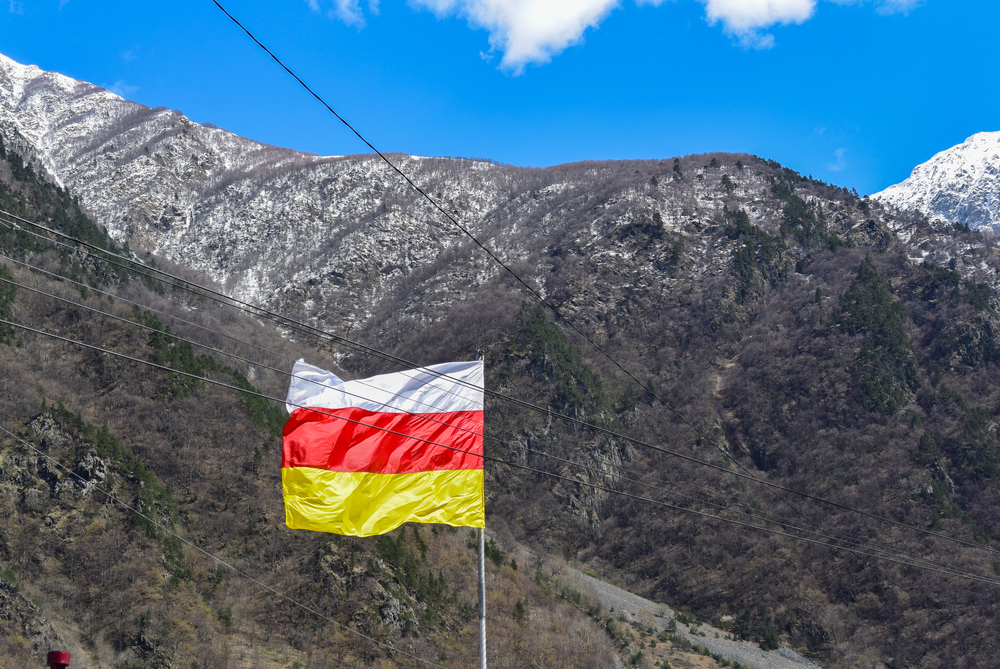
BACKGROUND:
On June 23, Alan Gagloev resigned from his post as President of the small breakaway republic of South Ossetia, taking a new position as an aide to Russian President Vladimir Putin. The move happened suddenly. Gagloev, in a televised address to the Ossetian people, claimed that after meeting Putin on June 22, he agreed to become an advisor to the Office of the Russian President. The next day he resigned. In his place, Prime Minister Marat Kambolov assumed the responsibilities of the presidency.
Kambolov is, notably, not a native to South Ossetia. A Russian national, Kambolov was sworn in as South Ossetia’s Prime Minister on June 17, 2026, but had until 2025 not been involved in the domestic affairs of the breakaway republic. Born in North Ossetia in 1965, he graduated from Moscow State Social University and the Russian Academy of Public Administration, going on to work in the Russian government. In May, he was tapped to be Gagloev’s advisor, and soon became Gagloev’s nominee for the premiership. Kambolov is expected to deepen Russo-Ossetian ties, implementing provisions of a bilateral treaty signed between Russia and Ossetia on May 9, 2026. Kambolov is expected to become the President of South Ossetia after snap elections planned September 18.
Kambolov’s ascension is part of a continuous effort of Ossetian aspirations for annexation into the Russian Federation. Indeed, since 1991 and with Russian backing, the Ossetians have maintained de facto independence from Georgia and alignment with Russia.
Generally, the South Ossetian separatist project is concerned with the unification of their people, whether it be within a sovereign state or under Russian rule. Indeed, the Ossetians are a transnational people, inhabiting Georgia, the unrecognized Republic of South Ossetia, as well as the Russian federal subject, the Republic of North Ossetia–Alania. As the vast majority of Ossetians reside in North Ossetia, it has been the wish of many in the south form a union with the north, to share a common state.
Ossetian demands for union with the north began in the early 90s, when the region broke from Tbilisi. In 1992, South Ossetia held a referendum that saw overwhelming support for independence by Ossetians and a 99.89 percent vote in favor for “reunion” with Russia.
Serious promotion of annexation did not begin until 2008, however, when Russia formally recognized the small de facto republic. After the election of Leonid Tibilov as South Ossetian president in 2012, it began making moves towards unionship. Tibilov stated after winning the 2012 elections that “We will certainly continue along the course towards Russia that has been chosen by our people – a course of further integration ... in all existing spheres, including the economy, as well as military, technical, and defense cooperation.” Other efforts towards union, such as the partial integration of the South Ossetian armed forces into the Russian army, also occurred during this period. In 2016, Ossetia signed the bilateral Treaty on Union Relations and Integration with the Russian Federation, strengthening ties between the two countries. Further plans for full annexation emerged at this time as well, with Tibilov suggesting closer union with Russia.
Plans for an annexation referendum did not pan out until 2022, where in March, South Ossetian president Bibilov announced a referendum following the 2022 presidential elections. Bibilov suggested it should take place the day after the presidential elections, thus constituting concrete executive action in contrast with earlier parliamentary debates on the organization of referendums. The referendum was delayed, however, by Gagloev who after winning the elections stated that the time was not right and signed a decree cancelling it.
Despite continued delays, Russo-Ossetian cooperation has continued with the culmination of talks leading to the signing of a bilateral treaty in 2026. On May 9, Vladimir Putin and Alan Gagloev signed a “Treaty on Deepening Allied Interaction,” which the Russian Duma ratified on May 13. The document outlines provisions that would enable Russian citizens to hold office in South Ossetia and establish greater energy, transportation, telecommunication integration between the Russian Federation and the de facto republic. In effect, the agreement would bring de facto annexation. Gagloev, the former president of South Ossetia, called it, a “step towards the reunification of the Ossetian people,” further emphasizing that “South Ossetians perceive Russia as [their] great homeland.”
IMPLICATIONS:
The recent appointment of Marat Kambolov as Prime Minister and his ascension to the role of acting president is a continuation of the integration and unification of Russia and South Ossetia, a process that has been ongoing since the South Ossetian war in 1991. Kambolov is a demonstration that Moscow is now installing administrators rather than cultivating local elites.
The events in South Ossetia demonstrate Moscow’s continuing exercise of influence in the South Caucasus, which is otherwise waning against the backdrop of its economic, military and political overextension due to its ongoing invasion of Ukraine. Russia has lost considerable influence in Armenia, as Prime Minister Pashinyan moves the country Westward and as President Aliyev of Azerbaijan continues to elevate Baku’s strategic autonomy.
This is evident as Gagloev noted that one of the reasons for the delay of the 2022 referendum was Russia’s invasion of Ukraine. As he stated, “I believe that the current authorities of the Russian Federation, represented by President Vladimir Putin, are still busy with other issues, I think with more serious ones.”
Setting aside Russia's insufficient political capital for outright de jure annexation, indirect rule is also part of Moscow’s strategy to manage Russo-Georgian relations. Since the Georgian Dream (GD) party’s rise to power in the early 2010s, Georgia began to employ a foreign policy that was multi-axis oriented, engaging in attempts at rapprochement with Russia. When Russia invaded Ukraine in 2022, the GD government refused to engage in the Western sanctions imposed on Moscow. GD likely believed that a swift Russian victory in 2022 was inevitable, and that maintaining friendly relations with Russia was Georgia’s most rational course of action. It is unclear whether there is a definitive grand strategy to GD’s foreign policy, yet the Georgian government clearly believes that cultivating better relations with Russia is in their interest.
This certainly incentivizes Moscow to maintain a friendlier attitude Georgia, however, at the same time Moscow acknowledges the utility of both South Ossetia and Abkhazia in the relationship. By continually utilizing South Ossetia as a bargaining chip, Moscow can promise Georgia speculative future talks on the fate of South Ossetia, and in return Georgia retains a neutral, or even semi-positive attitude towards Moscow. Of course, Russia has no intention of giving away South Ossetia, yet this strategy continues to work as GD continues its attempts at a multi-axis oriented foreign policy.
CONCLUSIONS:
Georgia remains strategically important for Russia, which hopes to control a North-South Axis, from the North Caucasus through Georgia and Armenia, cutting through the Middle Corridor and further linking up with Iran. This competes with the ongoing establishment of a West-East Axis from Turkey, through Armenia/Georgia and Azerbaijan and further to the Caspian and Central Asia.
It is evident that Russia, at least under the current strategic policies of the Putin regime, will seek to retain its influence in the South Caucasus for the foreseeable future. Moscow’s approach to integration in South Ossetia demonstrates its continued interest in the region, but also the limitations to its capacity for fulfilling them.
AUTHOR’S BIO:
Nicola Ilario is an undergraduate at the University of Pennsylvania. He studies Economics and History, with a concentration in the history of diplomacy. Nicola interned at the Central Asia-Caucasus Institute the Summer of 2026, assisting fellows in their research. He can be reached at This email address is being protected from spambots. You need JavaScript enabled to view it. .
Patriarch Shio III: A New Era in the Georgian Orthodox Church
By Irakli Kiknavelidze and Tomáš Baranec
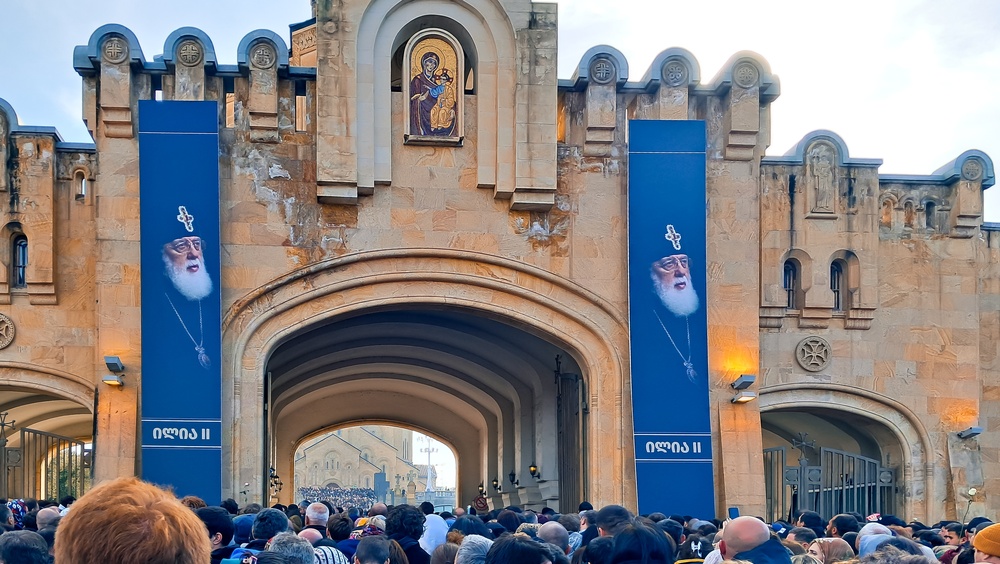
Ilia II of the Georgian Orthodox Church (GeOC) died on 17 March. Over nearly five decades, he consolidated the Church’s position as one of Georgia’s most influential and trusted institutions. His tenure was characterized by a dominant patriarchate, a relatively constrained Holy Synod, and a cautious approach to partisan politics and foreign policy alignment. The accession of Shio III marks the beginning of a new era for the GeOC, bringing expectations of a redefined balance between the patriarch and the synod, as well as potential consequences arising from the Church’s increased engagement in domestic and international politics.
BACKGROUND:
Under the 1995 Statute of Administration of the GeOC, the Holy Synod plays the central role in the election of the Patriarch. It is responsible for nominating three candidates and is the only body granted voting rights within the Extended Council, which selects the final candidate. All other participants, unlike under the pre-1995 system, serve solely in an advisory capacity.
Ideologically, the Holy Synod can currently be divided into three principal blocs. The conservative bloc is characterised by a dogmatic stance on cultural and ethical issues, scepticism towards Western integration, and, to varying degrees, openness to cooperation with the Russian Orthodox Church (ROC).
The national-conservative bloc often adopts an even more dogmatic position on cultural and ethical issues than the conservative bloc, while remaining strongly anti-Russian. Consequently, it is particularly sceptical of both the influence of the Russian Orthodox Church (ROC) and Georgia’s integration with Western institutions.
The liberal bloc, the smallest of the three, advocates more moderate positions on socio-ethical issues and is broadly supportive of Georgia’s political integration with Western institutions.
A heterogeneous yet numerically significant group within the Holy Synod consists of centrists, whose members are generally less ideologically committed and more pragmatic in their outlook than those belonging to the principal ideological blocs.
At its session on April 28, the Holy Synod nominated three candidates for the patriarchate, broadly reflecting the three principal ideological currents within the Church. Metropolitan Shio Mujiri, backed by the conservative wing, received 20 votes. The national-conservative bloc nominated Iob Akiashvili, who secured 7 votes, while the liberal wing put forward Grigol Berbichashvili, who also received 7 votes.
In the final vote held on 11 May, Metropolitan Shio Mujiri was elected head of the GeOC with 22 votes. Metropolitan Iob received nine votes, while Metropolitan Grigol secured seven. Mujiri was enthroned the following day, assuming the title Shio III.
IMPLICATIONS:
As one of the few senior figures within the GeOC to have received theological education in Russia, Shio has frequently been portrayed in the media as “Moscow’s candidate,” a characterisation openly used by Archbishop Zenon Iarajuli, among others. Critics have also pointed to his close relationship with Georgia’s ruling party. In contrast, Patriarch Ilia II maintained close ties with the Georgian state as an institution while generally avoiding overt alignment with any particular political party.
The accession of Shio III can be regarded as a significant success for the ROC, particularly with respect to the question of recognising the autocephaly of the Orthodox Church of Ukraine (OCU), which is a fully independent, autocephalous national church. Both of Shio’s rivals, Iob and Grigol, stated that they would support recognition of the OCU’s independence if elected. Shio, by contrast, avoided taking a public position on the issue during the election process. Given his longstanding ties to the ROC, it appears unlikely that he will endorse recognition of the OCU and will instead support the Moscow-affiliated Ukrainian Orthodox Church (UOC). As a result, the ROC can expect continued support from the GeOC on an issue of major strategic importance to Moscow, potentially for decades to come.
To an extent that remains uncertain, Shio’s accession is also likely to ensure the continuation of relatively close relations between the two Churches and to preserve a degree of ROC influence within the GeOC, at least intellectually and ideologically.
Compared with Ilia II, the new Patriarch’s initial public statements and appearances indicate that he may adopt a more uncompromisingly conservative stance, which will be difficult to reconcile with Georgia’s integration with Western institutions.
In this way, Shio may contribute to the strengthening of anti-Western attitudes among segments of the Georgian population. Such a development would align with Russia’s broader geopolitical interests while simultaneously reinforcing the legitimacy of the ruling Georgian Dream party among parts of its domestic constituency.
Even before his accession, Shio departed from Ilia II’s principle of supporting state institutions rather than specific political parties. Moreover, unlike Ilia II, Shio III is likely to enter his relationship with Bidzina Ivanishvili, the de facto leader of the ruling party, as a junior partner, at least initially.
An important factor in assessing the outlook of the new Patriarch is his background as a black (monastic) priest. Orthodox monasticism has traditionally been closer to the ROC (which is based on monasticism) than to the Greek Orthodox Church, which relies more heavily on white (married parish) clergy. As a result, Shio’s affinity with the Russian Orthodox world extends beyond his education in Russia. Whereas Ilia II’s faith was based on "Georgian Orthodoxy;" a faith with regard to the interests of the state, Shio III emphasizes Orthodoxy as a superior and supranational religious identity.
Shio III’s ties to Russia and support for the government appear to stem from deeply held personal convictions rather than political expediency. Consequently, a significant shift in these positions during his patriarchate is unlikely.
Nevertheless, the impact of Shio’s enthronement is likely to remain limited, at least during the initial years of his patriarchate. The fact that, after the first round of voting, when his victory had become virtually certain, there was no significant shift of centrist support in his favour (his tally increased by only two votes) suggests that members of the Holy Synod are not subservient to the new Patriarch and are prepared to oppose him if necessary.
Shio III has yet to display the political acumen that characterised Ilia II. His leadership is constrained by dogmatism and introversion, although he has shown an ability to rely on politically skilled allies and possesses some political instinct. The first major challenges of his patriarchate will reveal which of these traits proves more influential.
The GeOC will soon face several important internal challenges, including the appointment of seven vacant episcopal positions and the reform of the 1995 Statute of Administration. While there is broad agreement within the Holy Synod that the current statute requires revision, opinions differ sharply regarding its replacement. In addition, some bishops are actively advocating for the Church to publicly call for the release of political prisoners.
None of these issues falls within Shio III’s formal authority to decide unilaterally. To advance his preferred policies, he will need to secure the support of the Holy Synod. His handling of these challenges will provide an indication of his ability to shape the Church in accordance with his worldview.
CONCLUSIONS:
If Shio III consolidates his position, he could enable greater Russian influence within the GeOC and bolster the legitimacy of Georgian Dream among conservative voters. In the long term, however, this may weaken the Church’s broader social authority and deepen political polarization in Georgia.
In an alternative scenario, the Holy Synod could gain influence at the expense of the Patriarch. Even so, a major shift in the Church’s domestic or foreign policy positions is unlikely, as the recent patriarchal election demonstrated the continued dominance of the conservative wing within the Synod.
AUTHOR’S BIO:
Tomáš Baranec is a Research Fellow and Head of the Caucasus Program of the Slovak think tank Strategic Analysis. He worked for several years as a field researcher on the Georgian-Ossetian ABL. Tomas studied Balkan, Central European and Eurasian Studies at Charles University in Prague.
Irakli Kiknavelidze is a Georgian journalist, television host, political commentator, and media professional specializing in Georgian politics, democracy, religion, and South Caucasus affairs. He has worked in television, print, and digital media, producing interviews, analysis, and public affairs programming. Throughout his career, Kiknavelidze has focused on political developments, international relations, and the intersection of religion and public life in Georgia.
How Russia Won the Hybrid War in Georgia — and What the West Got Wrong
By David Dondua
The August 2008 Russo-Georgian war achieved less than Moscow had hoped. Russia seized 18 per cent of the country's territory, areas it had already controlled since the early 1990s, but failed to alter Georgia's strategic direction. What military force could not achieve, Moscow pursued through other means — disinformation, economic leverage, elite capture, and a sustained cognitive campaign targeting Georgian society's deepest cultural anxieties. Over the following decade and a half, these tools proved far more effective than tanks. Yet Moscow's campaign found the ground partly prepared for it. Western partners, through a series of miscalculations, inadvertently made the cognitive campaign easier to wage. Understanding what went wrong and why is essential not only for Georgia's future but also for every country facing Russian hybrid warfare.
Read How Russia Won the Hybrid War in Georgia

Georgia's Shifting Strategic Outlook and its Limits
By Giorgi Gvalia and Ivane Lomidze
Georgia’s foreign policy thinking is undergoing a notable shift. For much of the past two decades, the country’s strategic discourse was framed by democratic alignment and Euro-Atlantic integration. Today, however, the rhetoric of the ruling elite increasingly reflects a geopolitical logic, emphasizing survival, insecurity, and strategic calculation over value-based commitments. This shift is understandable for a small state operating in a highly vulnerable security environment. Yet the emerging approach also reveals an important limitation. While focused on avoiding risks vis-à-vis Russia, Georgia’s leadership gives insufficient attention to the equally important need to preserve and balance relations with Western partners that remain essential to Georgia’s long-term security, prosperity, and independence.

Photo by Czerep rubaszny, 2020
BACKGROUND:
Georgia’s foreign policy has long been associated with a clear strategic orientation toward Europe and the transatlantic community. For years, the dominant language of Georgian statecraft emphasized democratic reform, integration with Western institutions, and a value-based foreign policy identity. That discourse has not disappeared entirely, but it is no longer the main organizing principle of the ruling elite’s public messaging. Especially since Russia’s full-scale war against Ukraine, senior representatives of ruling Georgian Dream party have described foreign policy in much starker terms: the state must avoid steps that could trigger retaliation from Russia and must calibrate every decision with extreme caution.
This shift is rooted in Georgia’s hard security environment. Russia still occupies Abkhazia and South Ossetia and remains the overwhelmingly dominant military power in the region. The memory of the 2008 war continues to shape official thinking in Tbilisi, especially the lesson that strong Western political backing does not automatically translate into direct security protection. Against that background, the government has argued that Georgia cannot afford symbolic gestures that carry unclear benefits but potentially serious costs.
That logic was most clearly visible in the government’s refusal to impose sanctions on Russia after the full-scale invasion of Ukraine. Georgian officials have maintained that the country has cooperated with international efforts to prevent sanctions circumvention, but they have resisted taking additional unilateral steps that could be interpreted by Moscow as escalation. From the government’s perspective, such caution is not ideological sympathy for Russia but a practical response to Georgia’s exposed position. The argument is simple: a small country with occupied territories, no formal security guarantees, and limited means of self-defense should avoid unnecessary confrontation with a stronger and hostile neighbor.
This position has domestic resonance. Many Georgians remain deeply pro-Western, but there is also broad public sensitivity to the risks of war and instability. The government has used that sentiment to justify a foreign policy of restraint, presenting itself as the actor most capable of keeping Georgia out of the wider regional conflicts. In that sense, Georgian Dream’s message is not only strategic but political: it links restraint abroad to stability at home. The result is a more defensive and geopolitical foreign policy vocabulary than the one that dominated Georgian politics in the previous decades.
IMPLICATIONS:
The problem with Georgia’s current course is not that it recognizes geopolitical reality. Any rational Georgian foreign policy must take account of Russian power and the risks of direct confrontation. The problem, rather, is that the government appears to treat this as its overriding strategic priority, while underestimating the cost of alienating the Western partners that help Georgia offset its structural weakness. For small states, survival cannot be reduced to managing immediate threats alone. It also requires maintaining the external relationships that expand their room for maneuver and reduce the risk of abandonment.
Any viable national strategy must therefore be assessed along two dimensions simultaneously: whether it mitigates immediate threats and whether it preserves the external relationships on which long-term autonomy and resilience depend. In practice, this requires small states to reduce risks while sustaining partnerships that provide economic, political, and – over time – security support. However, recent developments suggest that Georgia’s current strategy has managed only one side of this equation. In other words, the government’s strategy appears to have minimized certain risks while simultaneously generating others. By prioritizing the avoidance of confrontation with Russia, Georgian Dream has struggled to maintain the political trust and strategic confidence of its Western partners.
Over the past years, Georgia’s relations with the West have deteriorated significantly. This trend has become increasingly visible in tensions surrounding Georgia’s EU candidacy process, the controversy over the “foreign agents” law, and growing Western criticism of the country’s political trajectory. Government officials have largely attributed this deterioration to Western pressure – particularly from the EU – for Georgia to adopt a harder line against Russia, including the imposition of unilateral sanctions following the invasion of Ukraine. However, that explanation is incomplete. Disagreements over sanctions policy alone do not account for the depth of mistrust that has emerged. Even where Tbilisi may have had legitimate reasons to resist certain Western demands, such differences could likely have been managed more effectively through sustained political engagement and clearer strategic communication. So far, Georgian Dream has not convincingly demonstrated that it has invested sufficient diplomatic effort in explaining Georgia’s security concerns to its Western partners while maintaining their confidence in the country’s broader strategic direction.
This matters because, for Georgia, relations with the West are not just symbolic. The EU remains central to Georgia’s trade, institutional modernization, and broader economic orientation. The U.S. has played a major role in strengthening Georgia’s state institutions and defense capacity. These links are not simply a matter of identity or values; they are practical assets that increase Georgia’s room for maneuver in a difficult neighborhood. If those relationships weaken, Georgia does not become more secure or more autonomous. It becomes more exposed.
The costs could rise further as the regional environment changes. Georgian policymakers have sought to position the country as a key corridor between Europe and Asia, especially through transit and connectivity projects crossing the South Caucasus. But Georgia’s geographic importance should not be taken for granted. Progress in the Armenia-Azerbaijan peace process and the discussion of alternative transport routes could gradually reduce Georgia’s comparative advantage as a regional connector. If Georgia’s strategic value becomes less automatic, the quality of its political ties with Western actors will matter even more.
For Georgia, geopolitical thinking remains unavoidable. Geography and power asymmetries ensure that any responsible foreign policy must account for the risks posed by Russia. The real challenge, however, is how to apply that thinking in a way that manages immediate security threats while preserving the partnerships that remain essential for Georgia’s long-term prosperity and independence. For a small state caught between powerful neighbors and strategic partners, the art of survival lies precisely in maintaining that balance.
CONCLUSIONS:
Georgia’s foreign policy is entering a new phase defined less by idealistic rhetoric and more by the language of risk, constraint, and survival. That adjustment is understandable. Russia’s military presence on Georgian territory and the wider regional security climate leave little room for carelessness. But this approach, if applied too narrowly, can ultimately undermine its own objectives.
It is sensible to avoid policies that would impose immediate and disproportionate costs on the state. However, such caution is insufficient if it rests on the assumption that prudence vis-à-vis Russia alone can secure Georgia’s future. Over the longer term, the country’s sovereignty and prosperity remain closely tied to the preservation of robust relations with the West. If Tbilisi cannot preserve those ties while managing Russian pressure, it will trade one form of vulnerability for another. For Georgia, the central challenge of statecraft lies not merely in avoiding conflict in the present, but in doing so without eroding the external partnerships upon which its future security and development depend.
AUTHOR’S BIO:
Giorgi Gvalia is Professor of International Relations and Jean Monnet Chair at Ilia State University in Tbilisi, specializing in small-state foreign policy, Realist IR theory, and South Caucasus geopolitics. Ivane Lomidze is Associate Professor of Sociology at Ilia State University, whose work focuses on the normative and theoretical foundations of political realism.
Georgia’s Technology Export Sector: Growth Drivers and Structural Constraints
By Giorgi Tsikolia
In 2025, Georgia’s information technology sector generated $1.15 billion in export revenue—a 67 percent increase year-on-year and more than a thirteen-fold rise from the sector’s 2017 baseline.[1] This paper traces the policy, diplomatic, and private-sector decisions that produced that outcome. It then examines three constraints—labor market restrictions on foreign workers, the absence of government as a technology customer, and Georgia’s exclusion from U.S.-led AI infrastructure investment—that directly affect whether the sector’s growth continues.
[1] National Bank of Georgia, Statistics Portal, https://nbg.gov.ge/en/statistics
Read Georgia’s Technology Export Sector

Visit also