Eurasian Economic Union Summit: The Limits Of Geopolitical Integration
By Farkhod Tolipov
On May 29, 2026, the Supreme Eurasian Economic Council convened in Astana, Kazakhstan, bringing together representatives of the five Eurasian Economic Union (EAEU) member states and one observer state. Armenia was represented by its Deputy Prime Minister rather than the Prime Minister, while observer Uzbekistan was represented at the highest level by its President. Although the summit followed a largely routine agenda, discussions were overshadowed by speculation regarding Armenia’s potential withdrawal from the Union. In contrast, Uzbekistan maintained its traditionally supportive stance toward Eurasian integration. These developments suggest that the EAEU may have reached the limits of its current institutional composition and geopolitical configuration.

BACKGROUND:
The EAEU, established in 2015, succeeded the Eurasian Economic Community (EAEC), which existed from 2001 to 2014. Both organizations were founded with the objective of creating an economic foundation for deeper integration among the former Soviet republics. They emerged within the broader framework of the Commonwealth of Independent States (CIS), established in 1991 following the dissolution of the Soviet Union. While the USSR consisted of 15 union republics, the CIS began with 12 member states and has since contracted to eight. The EAEC comprised six member states, whereas the EAEU currently includes five.
When the CIS was established, many experts and politicians described it as a framework for the “peaceful divorce” of the former Soviet republics. In retrospect, this assessment appears largely correct. Rather than promoting deeper integration, the CIS, the EAEC, and the EAEU have experienced gradual contraction and persistent disagreements. In the context of Russia’s war against Ukraine, Moscow has sought to preserve the remaining cohesion of this declining integration project. As part of these efforts, it introduced so-called informal meetings of EAEU heads of state. This is the backdrop for the May 2026 EAEU summit in Astana.
The EAEU summit in Astana coincided with Vladimir Putin’s second state visit to Kazakhstan. Observers focused less on the outcomes of the visit than on President Kassym-Jomart Tokayev’s remarks during the official welcoming ceremony. Tokayev described Russians and Kazakhs as brotherly nations sharing a common history, cultural traditions, and mentality. Such a warm reception for a leader conducting a war against Ukraine and widely criticized by the international community may negatively affect Kazakhstan’s international reputation.
While Armenia was represented by its Vice Prime Minister, the summit was attended by the presidents of the four other EAEU member states as well as Uzbekistan. The agenda was largely routine, focusing on logistics, digitalization, free trade, and artificial intelligence. Beyond these issues, the leaders of the four member states adopted a special statement concerning Armenia, expressing concern over its possible withdrawal from the EAEU and its aspirations for EU membership. The statement was delivered to the Armenian Vice Prime Minister, who reaffirmed his country’s intention to remain in the EAEU while safeguarding its national interests and respecting those of the other member states.
President Putin emphasized the incompatibility of simultaneous membership in the EAEU and the EU and warned Armenia of the economic consequences of leaving the EAEU. His remarks, resembling an ultimatum, amounted to a clear signal that Russia would reconsider existing trade and economic arrangements with Armenia should it withdraw from the Union. This position once again highlighted the predominantly Russia-centered nature of the EAEU, rather than a genuinely multilateral integration framework among equal members. In contrast, Uzbek President Shavkat Mirziyoyev reaffirmed that closer cooperation with the EAEU remains a key foreign policy priority for Uzbekistan.
IMPLICATIONS:
The EAEU summit in Astana took place in a complex geopolitical setting. Earlier, on May 15, Kazakhstan hosted an informal summit of the Organization of Turkic States (OTS) in Turkistan. Among other issues, OTS leaders discussed cooperation in artificial intelligence and digitalization, the same topics featured on the EAEU agenda. This overlap raises questions about the compatibility of integration initiatives pursued by the two organizations. It remains unclear how AI and digitalization strategies developed within the potentially competing frameworks of the OTS and the EAEU can coexist.
The summit was preceded by Donald Trump’s visit to China and Putin’s subsequent visit, both demonstrating renewed geopolitical activism. For Central Asian states, these events underscored the significance of the US–Russia–China geopolitical triangle, whose rivalry they observe with growing concern. Against this backdrop, the EAEU summit of “five minus one” member states appeared overshadowed by broader great-power competition.
The EAEU summit in Astana was also preceded by a series of high-profile diplomatic initiatives by Uzbekistan. In April, Saida Mirziyoyeva, Head of the Presidential Administration, visited Washington, D.C., for the launch of the American–Uzbek Business and Investment Council. On May18, she traveled to London, where she met British officials, international investors, and representatives of the London Stock Exchange following the IPO of the Uzbekistan National Investment Fund (UzNIF). On May 24, she visited New Delhi and held talks with U.S. Secretary of State Marco Rubio on trade and investment cooperation. These developments reflected Uzbekistan’s active engagement with Western partners in the weeks preceding the EAEU summit.
On April 15, President Mirziyoyev received a Russian delegation led by Sergey Kiriyenko, First Deputy Chief of Staff of the Presidential Administration and former head of Rosatom. According to official reports, the talks focused on implementing previously reached agreements and deepening the Uzbek–Russian strategic partnership and alliance. Against the backdrop of Uzbekistan’s intensive diplomatic engagement with Western partners, the EAEU summit in Astana appeared relatively modest and somewhat ad hoc. This reflected Russia’s preference for advancing its interests through bilateral relations rather than through the Union’s multilateral framework.
Rather than presenting itself as a dynamic and cohesive economic bloc, the EAEU revealed its geopolitical dimension. During the summit, Putin suggested that developments in Armenia could follow a trajectory similar to that of Ukraine. While such a scenario appears unlikely, this rhetoric may prove counterproductive. Russian pressure on Armenia is likely to deepen anti-Russian sentiment among Armenians and further strengthen the country’s orientation toward Europe.
For Central Asia, regional integration is challenged by Russia’s continuing geopolitical ambitions. While the EAEU has experienced contraction, regional cooperation in Central Asia is expanding, exemplified by Azerbaijan’s accession to the Community of Central Asia last year. Thus, while Armenia and Georgia seek closer integration with the EU, Azerbaijan strengthens its role within the Central Asian regional framework. In this evolving geopolitical environment, the OTS gains a new opportunity to emerge as a viable alternative to the EAEU.
CONCLUSIONS:
Zbigniew Brzezinski once predicted that the EAEU would struggle to survive beyond 10–20 years, arguing that its ideological foundation, Eurasianism, was both outdated and geopolitically unsustainable. This ideology has found limited resonance in Central Asia and other former Soviet republics. From this perspective, the EAEU masks a tacit divergence between its member states and an increasingly assertive Russia.
The EAEU seems to have reached its peak in composition and geopolitical design. It becomes quite obvious that its makeup can be only five members or even less, and that the EAEU is losing its attractiveness. It looks like another “C5” (to use the Central Asian “C5+1” formula), however, it would become a “C5-1” if Armenia should withdraw, possibly returning to “C5” if Uzbekistan would join. This again underscores the geopolitical nature of the EAEU and the limited attractiveness of Eurasianism. Central Asia should take note of Russia’s ultimatum to Armenia and its increasingly belligerent posture toward former Soviet republics.
In November 2025, the 7th Consultative Meeting of Central Asian Heads of State was held in Tashkent, where participants agreed to transform the Consultative Meetings into the Community of Central Asia (CCA). Azerbaijan became a full member of the new organization. The 8th summit, expected to take place in Turkmenistan this year, will be the first meeting of the newly established Community. However, the membership of Kazakhstan and Kyrgyzstan in the EAEU, and Uzbekistan’s observer status, risk reducing the CCA to a largely symbolic project. As a result, the concept of the CCA remains vague, its institutional model underdeveloped, and its future trajectory uncertain.
AUTHOR’S BIO:
Dr. Farkhod Tolipov holds a PhD in Political Science and is Director of the Research Institution “Knowledge Caravan”, Tashkent, Uzbekistan
History Repeating Itself: Is Russia Trying to Ruin Central Asian Integration Efforts?
By Farkhod Tolipov
In mid-December 2025, several Russian state-controlled media outlets spread a rumor that Russia could apply for membership in the Central Asian Community. This statement followed Azerbaijan’s entry into the regional grouping in November at the 7th Consultative Meeting of the Heads of State of Central Asia, held in Tashkent. The rumor reminded of Russia’s accession to the Central Asian Cooperation Organization in 2004, which led to the merger of that body with the Russia-led Eurasian Economic Community. Once again, Russia seeks to join the Central Asian Community, potentially worsening geopolitical tensions in the region.
BACKGROUND: Twenty years ago, in 2004, Russia applied for membership in the Central Asian Cooperation Organization (CACO). At that time, the presidents of two key states, Kazakhstan’s Nursultan Nazarbayev of and Uzbekistan’s Islam Karimov, were unable to refuse Moscow. This external membership in CACO eventually led to the organization’s collapse. One year after Russia’s admission, CACO was merged with the Russia-led Eurasian Economic Community (EvrAzES) on the grounds that the two organizations duplicated each other. Uzbekistan withdrew from EvrAzES in 2008. The structure itself existed until 2014, and in 2015, it was replaced by the Eurasian Economic Union (EAEU). Only two Central Asian states, Kazakhstan and Kyrgyzstan, are now members of the EAEU.
In 2019, the Russian side suddenly announced that Uzbekistan could become a member of the EAEU. Uzbekistan never confirmed either its desire or the possibility of such membership but decided in December 2020 to become an observer in the EAEU. Since then, Moscow has constantly and officially reminded Uzbekistan that the EAEU is waiting. Recently, the President of Belarus Aleksandr Lukashenko even stated that “we are looking forward to Uzbekistan’s membership in the EAEU.” Notably, such statements come only from Russia or Belarus; other EAEU states are not focused on this, and Uzbekistan does not show a strong interest in joining the organization.
Against this backdrop, two geopolitical issues cause concern in Moscow. First, without Uzbekistan in the EAEU, Central Asia cannot be brought under full Russian control. Second, the EAEU remains a very small entity, consisting of only five former Soviet republics. This limited composition does not support Russia’s image as a great power but, on the contrary, highlights its difficulty in asserting such a status.
It has become a tradition that the informal summits of the EAEU and the CIS are held in Saint Petersburg on the same days. On 22–23 December 2025, both events took place in the city. Reports on the CIS/EAEU summits were quite modest and contained no serious statements, except positive remarks about increased trade within the CIS/EAEU during the year. These largely symbolic events took place against the background of the war in Ukraine, which has dealt a serious blow to Moscow’s international reputation. In this context, Russia is using different means to preserve its influence in Central Asia while losing control over other parts of the former Soviet space.
IMPLICATIONS: Azerbaijan’s president Ilham Aliyev did not attend the EAEU summit, citing his country’s non-membership in the organization. He also did not travel to Saint Petersburg for the CIS summit, referring to his busy schedule. However, in November Azerbaijan became a full participant in the Consultative Meetings of the Heads of State of Central Asia (CMHS).
Although Baku’s accession to the CMHS is assessed differently across the region, this expansion of the “C5” format into a “C6” is likely viewed in Moscow as a new challenge to Russia’s position in the region of the “stans.” This may explain the appearance of rumors that Russia could apply for membership in the CMHS. At the same time, the increasingly pro-Russian policies of all Central Asian states, whether genuine or aimed at avoiding Moscow’s displeasure, raise concerns that history may repeat itself and that the Central Asian Community could again open its doors to Russia.
Uzbekistan’s President Shavkat Mirziyoyev delivered a speech at the meeting of the Supreme Eurasian Economic Council that resembled a statement from a full member. He described EAEU countries as “our strategic and natural partners.” According to the president, Uzbekistan actively participates in all key Eurasian formats. He also stated that “we believe it is necessary to strengthen coordination between the institutions of the CIS and the EAEU.”
Mirziyoyev highlighted several issues, including the elimination of trade barriers and the creation of an Uzbekistan–EAEU coordination group on tariff and non-tariff barriers; the development of industrial cooperation and the launch of joint projects in machinery, energy, agriculture, and the chemical sector; the digitalization of trade and customs administration; participation in EAEU technological platforms, from biomedicine and new materials to robotics; and the creation of a unified tourism space that would combine products of the Union’s member states.
Overall, the narrow, trade- and business-centered rhetoric surrounding the EAEU does not indicate the emergence of a shared regional identity among its member states, which is both a key condition for and an outcome of meaningful integration. In contrast, a broader vision of Central Asia, based on a natural sense of common identity among its peoples, is far stronger than a solely economic grouping of states. Indeed, the November summit of Central Asian leaders in Tashkent produced notable signs of deeper regional integration. In particular, it was announced that the CMHS format could be transformed into a Community of Central Asia (CCA).
Despite this major trend in Central Asia, the pro-Russian, or seemingly pro-Russian, policies of regional leaders may have a reverse effect and lead to a repetition of history, including a renewed Russian application for membership in the CCA for purely geopolitical reasons. In a recent and telling statement, Russia’s ambassador to Uzbekistan claimed that “Uzbekistan assured the Russian Federation that the era of the Great Game has passed into oblivion.” The remark suggests the opposite: the Great Game may be entering a new phase in which it is not Uzbekistan or other Central Asian states that shape geopolitical rivalry, but Russia itself, which continues to view the region through the lens of great-power competition. Throughout its independence, Uzbekistan has sought to avoid geopolitical entanglements. Therefore, if assurances about the end of geopolitical games are needed, they should come from great powers themselves, rather than from Central Asian states.
Moscow may believe that Russia’s membership in CAC would signal the end of the Great Game, whereas in reality it would represent yet another expression of Russia’s enduring geopolitical modus vivendi.
CONCLUSIONS: Central Asia is entering a new round of the geopolitical Great Game, and this game is being driven primarily by Russia. In the context of the war in Ukraine, this outcome is hardly surprising. Moscow’s foreign policy and its broader international behavior are clearly dominated by geopolitical considerations.
At present, one can observe the emergence of two opposing geopolitical configurations, the “Eurasian Five” of the Eurasian community versus the “Central Asian Six” of the Central Asian Community. The paradox of this dual trend, however, is that two Central Asian states, Kazakhstan and Kyrgyzstan, are members of both EAEU and CAC.
In 2004, Russia’s accession to CACO distorted, weakened, and ultimately destroyed the organization and the broader process of integration among the five Central Asian states. As a result, regional integration was halted for a decade and revived only in 2017. Integration in Central Asia is a distinct phenomenon: from the outset, it has been shaped in part to avoid geopolitical entanglements. By its nature, Central Asian integration cannot include any major power, regardless of which one it is, because such inclusion would inevitably introduce a dimension of geopolitical competition into the integration process.
AUTHOR’S BIO: Dr. Farkhod Tolipov holds a PhD in Political Science and is Director of the Education and Research Institution “Bilim Karvoni” (“Knowledge Caravan”) in Tashkent, Uzbekistan.
Kyrgyzstan and the Changing Geopolitics of Central Asia and the Caucasus
By Shairbek Dzhuraev
August 30, 2022
Ever since 1991, Kyrgyzstan's international relations have focused on balancing its relation with Russia with developing new international partnerships. In the past decades, the task has become increasingly difficult, as exposed by the war in Ukraine. In the meantime, China has become a critical actor holding the keys to multiple economic issues in the region. Cooperation remains the narrative of Kyrgyzstan's relations with its Central Asian neighbors, although developments on the ground feature a fair share of unresolved conflicts. The paper reviews key developments in Kyrgyzstan's international relations and concludes by highlighting the strengths and weaknesses of the country's foreign policy approach.
Georgia’s prime minister visits Armenia

By Erik Davtyan
October 3rd, the CACI Analyst
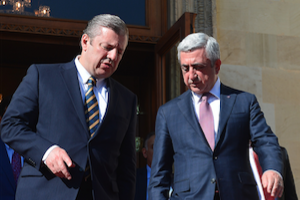
On September 5, Georgia’s Prime Minister Giorgi Kvirikashvili, along with Vice Prime Minister and Minister of Energy Kakha Kaladze, and Deputy Minister of Foreign Affairs David Dondua, paid a one-day visit to Yerevan. Kvirikashvili has previously visited Armenia as Minister of Economy and Sustainable Development, however this was his first official visit after he became Prime Minister in December 2015. The visit came nearly a month before parliamentary elections in Georgia, which are set for October 8. Less than one week before, Kvirikashvili made a similar visit to Azerbaijan. During both visits, the Georgian delegation was composed of exactly the same level of representatives, although another deputy foreign minister was present in Azerbaijan – indicating the importance that Georgian authorities attach to demonstrating a balanced policy towards its two neighbor states.
The Nagorno-Karabakh conflict at the center of Russia-Armenia relations

By Erik Davtyan
May 13th, the CACI Analyst
The unprecedented escalation of the Nagorno-Karabakh conflict on April 2-5 is the topic of a process of intense discussions between Russian and Armenian authorities. After the Chiefs of Staff of Armenia’s and Azerbaijan’s armed forces, Yuri Khachaturov and Najmaddin Sadigov, reached an oral ceasefire agreement in Moscow, Russia immediately activated its policy toward the conflict, including several high-level visits to Yerevan and Baku for discussions with the respective authorities.
Visit also