Japan Enters Central Asia's Congested Geoeconomic Market
By Emil Avdaliani
On December 19–20, 2025, the heads of state of the five Central Asian countries met with Japanese Prime Minister Sanae Takachi in the C5+1 format. This marked the fifth such summit involving Central Asian leaders in 2025. Japan’s growing engagement with the region is driven primarily by interest in mineral extraction and processing, sectors that have attracted increasing competition from major Asian and Western powers. Tokyo’s evolving approach reflects broader global dynamics and heightened tensions over supply chains. Rather than seeking to exclude other external actors or assume a leading security role in Central Asia, Japan is pursuing a pragmatic strategy centered on economic cooperation. Through economically attractive initiatives, it aims gradually to strengthen its geopolitical position in the region.
BACKGROUND:
In December 2025, Tokyo hosted its first Central Asia Plus Japan Dialogue, representing an upgraded version of a cooperation framework originally established in 2004. The region has thus evolved from a relatively peripheral area into a significant area in Japan’s foreign policy.
A series of agreements was concluded during the summit. Uzbekistan and Japan elevated their relationship to an expanded strategic partnership, prioritizing cooperation in green energy, the IT sector, deep industrial decarbonization, and the development of critical minerals, including uranium supplies. The two sides plan to implement projects worth over US$12 billion through a joint investment platform and the establishment of an economic zone in the Samarkand region.
Japan will also extend yen-denominated loans to Uzbekistan for the procurement of medical equipment and to improve small and medium-sized enterprises’ access to financial resources. In addition, Uzbek President Shavkat Mirzioev proposed holding biennial summits at the head-of-state level and initiating the development of a Cooperation Strategy between Central Asia and Japan.
For Japan, Kazakhstan and Uzbekistan stand out because of their geographic position, economic potential, and human resources. However, Tokyo is also deepening engagement with other regional actors. Turkmenistan, for example, concluded eight investment agreements with Japanese firms. In Tajikistan, Japan has expressed interest in developing logistics and transport infrastructure, as well as in the extraction and processing of minerals and rare earth elements.
Japan and the Central Asian states also established cooperation in the fields of artificial intelligence and medicine. The parties proposed the creation of a Central Asia–Japan digital hub to promote collaboration in artificial intelligence, cybersecurity, the Internet of Things, and digital technologies.
Following the summit, a multilateral business forum was convened at which several joint projects were announced. These included the construction of solar power plants in Uzbekistan by Sumitomo, Chubu Electric Power, and Shikoku Electric Power, supported by the Japan Bank for International Cooperation (JBIC) and Nippon Export and Investment Insurance (NEXI); the establishment of a medical center by Sojitz; and critical minerals mining projects involving the Japan Organization for Metals and Energy Security (JOGMEC).
IMPLICATIONS:
For the Central Asian states, closer ties with Japan form part of a broader strategy to pursue a more multi-aligned foreign policy, extending beyond reliance not only on Russia and China but also on the EU and the U.S. Japan is regarded as a reliable and responsible source of investment, particularly in sectors such as green energy and infrastructure. With its considerable technological expertise and development experience, Tokyo is in a strong position in the competition for influence in Central Asia.
Japan nevertheless faces structural constraints as an investor that limit its geopolitical weight in Central Asia. Geography constitutes the primary obstacle: there are no direct overland or maritime routes linking Japan to the region. Central Asia’s landlocked position, combined with its considerable distance from Japan, will continue to impose significant constraints on bilateral relations. Consequently, Japan is unlikely to emerge as a major geopolitical actor in the heart of Eurasia. It will remain structurally disadvantaged especially vis-à-vis Russia and China, but also in comparison to the EU and the U.S.
Second, Japan interest in security and military cooperation in the region is limited. Instead, it has primarily relied on soft power as its principal instrument of influence in Central Asia. For example, Tokyo has long supported Kazakhstan in assisting victims of Soviet-era nuclear testing by providing medical and technical aid, particularly to residents of the Abay region, where the Semipalatinsk nuclear test site is located. Other Central Asian states likewise receive substantial financial assistance from Japan. Notably, Tokyo offers various forms of partnership that are not formally conditioned on requirements related to democracy or human rights reforms.
Tokyo has demonstrated particular openness to cooperation in the extraction and processing of minerals and rare earth elements (REEs). This focus reflects the heightened global attention Central Asia has received in recent years due to its resource base, which is critical for global supply chains. Japan seeks to diversify its mineral and REE imports away from China. This is not the first indication of Japanese interest in the region’s rare earth sector. In the 2010s, Tokyo participated, albeit briefly, in the Stepnogorsk project in Kazakhstan before withdrawing from the initiative. The December summit, however, signaled a renewed commitment to the mineral sector, underscored by a pledge to invest approximately US$ 19 billion over the next five years in developing supply chains in the region.
In this context, Kazakhstan introduced the Next-Generation SmartMining Plus initiative, aimed at digitalizing the mining industry. Discussions also addressed the first-ever shipment of gallium, a rare metal used in electronics and semiconductors, from Kazakhstan, a development of particular significance given China’s dominant position in global gallium production.
The intensifying competition for Central Asia’s REEs and other critical minerals forms part of a broader contest over the region’s resource base. The EU, Russia, China, the U.S., and other actors all perceive substantial untapped potential in Central Asia.
Although Japan is a relatively late entrant into this competition, its pledge to invest US$ 19 billion is notable, as no other external power has committed a comparable sum. The closest parallel is the EU’s plan to mobilize €12 billion under its Global Gateway initiative, which aims to enhance connectivity across Eurasia and strengthen the Union’s competitiveness vis-à-vis China’s Belt and Road Initiative (BRI).
Tokyo is capitalizing on Central Asia’s preference for engaging a wide range of external partners. It has also identified sectors in which the region remains particularly vulnerable and receptive to external support. One such domain is the rapidly evolving landscape of Eurasian connectivity.
In the context of the war in Ukraine and the increasing efforts by the EU, India, China, and other actors to develop alternative overland trade routes, the so-called Middle Corridor, linking the Black Sea to China’s western region of Xinjiang, has gained strategic prominence. Japan’s support for strengthening east–west connectivity in Central Asia reflects an effort to reduce Russia’s historically entrenched influence over the region’s infrastructure and economic networks. This strategic logic underpins Tokyo’s commitment to further development of the Middle Corridor.
CONCLUSIONS:
Japan’s expanding engagement with Central Asia reflects both its own foreign policy recalibrations and the intensifying competition among Asian and Western powers for access to the region’s strategic resources. Rivalry among Asian actors in particular has grown more pronounced, with China, South Korea, India, and several ASEAN member states all seeking to deepen their ties with Central Asia.
Compared to Russia and China, however, Japan’s ambitions remain more cautious. Rather than pursuing dominance, Tokyo aims to position itself as a facilitator of existing regional dynamics. Support for the expansion of the Middle Corridor and for the extraction and processing of REEs and other critical minerals aligns with Japan’s objective of mitigating Moscow’s and Beijing’s potential monopolistic influence in these sectors.
AUTHOR’S BIO:
Emil Avdaliani is a research fellow at the Turan Research Center and a professor of international relations at the European University in Tbilisi, Georgia. His research focuses on the history of the Silk Roads and the interests of great powers in the Middle East and the Caucasus.
Japan as no “other”: Decolonizing Alternative for Central Asia?

Japan as no “other”: Decolonizing Alternative for Central Asia?
By: Timur Dadabaev
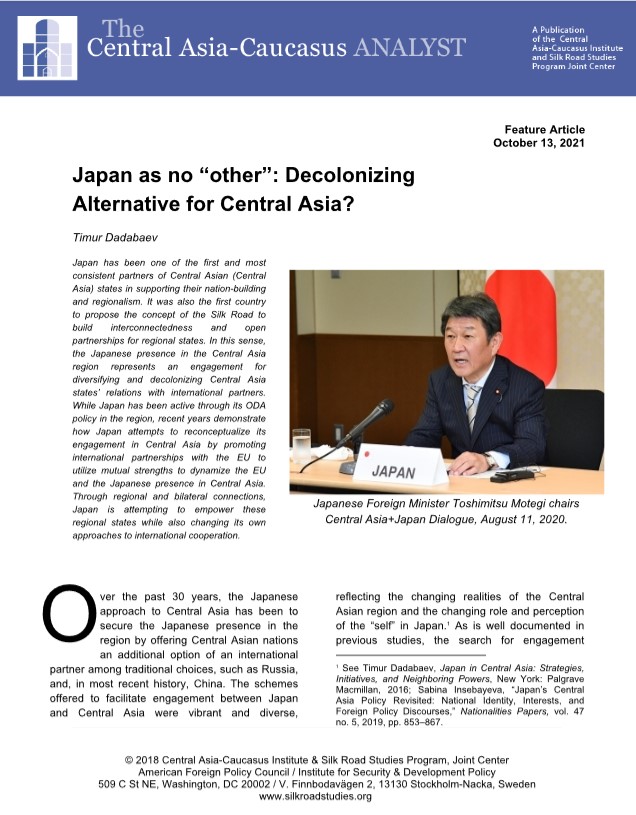 Japan has been one of the first and most consistent partners of Central Asian (Central Asia) states in supporting their nation-building and regionalism. It was also the first country to propose the concept of the Silk Road to build interconnectedness and open partnerships for regional states. In this sense, the Japanese presence in the Central Asia region represents an engagement for diversifying and decolonizing Central Asia states’ relations with international partners. While Japan has been active through its ODA policy in the region, recent years demonstrate how Japan attempts to reconceptualize its engagement in Central Asia by promoting international partnerships with the EU to utilize mutual strengths to dynamize the EU and the Japanese presence in Central Asia. Through regional and bilateral connections, Japan is attempting to empower these regional states while also changing its own approaches to international cooperation.
The Pap-Angren Railway and Its Geoeconomic Implications for Central Asia

By Mirzohid Rahimov
April 19th, 2016, The CACI Analyst
Central Asian nations consider the development of alternative regional transport communications important aspects of their national economic and political strategy, and the republics have become active participants in various international projects to promote economic cooperation with different countries and regions of the world. The development of internal Central Asian communication networks in general, and Uzbekistan in particular, gives the possibility of extending not only national communications, but also broaden networks in Central Asia. The Angren-Pap rail project is very important for national connectivity and for increased international communication. Different international experiences in economic transformation are relevant for Central Asia’s regional connectivity.
Central Asia, the AIIB and the advent of 5G communication

By Kairat Bekov and Gregory Gleason
April 1st, 2016, The CACI Analyst
Competition over technological advantage has replaced rivalry over territorial advantage in the great games of contemporary Central Asia. One of the main thoroughfares of the modern “Silk Road” is the telecommunications highway. The impending advent of fifth generation telephone technology is opening yet a new sphere of interaction among the countries of Central Asia offering as many opportunities for regional cooperation as it creates for competition.

TAPI and India's energy diplomacy

By Sreemati Ganguli
February 5th, 2016, The CACI Analyst
The recent ground-breaking ceremony of the Turkmenistan-Afghanistan-Pakistan-India (TAPI) pipeline, was followed by several Indo-Russian Memoranda of Understanding (MoUs) on energy during the 16th annual Indo-Russian Summit in Moscow in December 2015. These events add to Rosneft’s decisions in 2014 to buy a 49 percent share in Essar Oil in mid-2015 and to cooperate with OVL, both Indians companies, on exploration and hydrocarbon production in Russia’s offshore Arctic. Also, Prime Minister Narendra Modi visited Central Asia in July 2015, particularly Kazakhstan and Turkmenistan, to declare India’s growing importance as an alternative energy market in Eurasia, aside from the EU, China and Japan, and as a potential power in the energy-rich Eurasian space.
Visit also