TRIPP's Future in the Context of the U.S.-Iran War
By Suren Sargsyan
The U.S.–Iran conflict, along with repeated failed negotiations, shows no clear path to resolution, and its future trajectory, consequences, and broader implications remain uncertain. Although a substantial body of research and commentary seeks to forecast developments in the Middle East, there is limited analysis of how this conflict may affect the South Caucasus, particularly in terms of future U.S. engagement in the region and the prospects of the Trump Route for International Peace and Prosperity (TRIPP) project. From Tehran’s perspective, TRIPP may constitute a legitimate target, as it conflicts directly with Iranian interests. It is therefore essential to assess the risks that the Iran–U.S./Israel conflict poses to the TRIPP project.
BACKGROUND:
A defining feature of the Trump administration, distinguishing it from its predecessors, is a marked increase in U.S. engagement with the South Caucasus. This was demonstrated by the approval of the TRIPP project and the announcement of peace between Armenia and Azerbaijan under U.S. mediation. However, U.S. involvement in the region clearly extends beyond relations with Armenia and Azerbaijan alone.
The implementation of TRIPP also aligns with broader U.S. regional interests, particularly in terms of isolating Iran. Currently, Azerbaijan’s shortest direct land connection to its exclave, Nakhichevan, runs through Iranian territory. If implemented, TRIPP would enable Azerbaijan to reduce its reliance on Iran by providing an alternative route. Such a development would also diminish Iran’s importance for Armenia, making Yerevan less dependent on the Iran–Armenia border, especially if accompanied by substantive progress in Armenia–Turkey relations, a goal the U.S. has supported since the George H. W. Bush administration.
Therefore, TRIPP should not be understood merely as a mechanism for regulating Armenian–Azerbaijani relations through the establishment of direct connectivity between the two states. Rather, it should be viewed as a broader geopolitical project, which will among other outcomes diminish the strategic significance of Iran for both Armenia and Azerbaijan, particularly by reducing their reliance on shared borders and transit routes through Iranian territory.
IMPLICATIONS:
Since the outbreak of the war, the United States and Israel have targeted not only Iranian military assets but also infrastructure of major strategic importance. Iran has incurred substantial losses, including damage to its naval capabilities, the elimination of senior political and military figures, and significant economic disruption. The closure of the Strait of Hormuz has further imposed considerable costs on the Iranian economy. In response, Iran has launched missile strikes not only against Israel but also against U.S. military bases within its operational range, despite these bases being located on the sovereign territory of states that have not formally joined the anti-Iran coalition.
Moreover, Iran has expanded its targeting beyond U.S. military installations in neighboring states to include economic infrastructure linked, directly or indirectly, to U.S. interests. From Iran’s perspective, there appear to be few meaningful geographical constraints. Rather, its strategy is to impose maximum costs not only through direct confrontation but also by targeting U.S.-associated economic projects and interests across the region and its immediate periphery.
From this perspective, the TRIPP project could also emerge as a potential target. As a major infrastructure initiative involving significant U.S. investment and the presence of U.S. security personnel, it carries clear strategic implications. Therefore, if tensions persist over an extended period and the conflict’s geographical scope expands, it cannot be excluded that this transportation corridor may eventually be targeted by Iran, despite Tehran’s relatively cooperative relations with Armenia.
This risk is underscored by reports of Iranian drones appearing over Azerbaijani territory, developments that have already provoked strong reactions. Although Iran denied these allegations, the incident nevertheless generated significant strain in bilateral relations and may be interpreted as a signal. There is no guarantee that Iran would refrain from deploying drones in the area, conducting limited troop movements, or undertaking other preventive or deterrent measures against the TRIPP project. Such a scenario becomes more plausible if tensions persist, hostilities intensify, and U.S. forces begin targeting Iranian infrastructure that has thus far remained largely intact, including power grids, transportation networks, and other critical facilities.
At the same time, it should be noted that there is currently no official information regarding the status of the project’s construction, at least on Armenian territory, where it is reportedly financed by the U.S. government. Although Armenia’s Foreign Minister has indicated that the intensity of Armenian–U.S. contacts concerning the project has not diminished, he has not addressed the timeline for the implementation of construction activities.
Even a single strike on this corridor would likely make potential investors and commercial actors significantly more cautious about using it for cargo transportation or committing to further infrastructure investments, given the associated security risks. Although detailed data on the expenditures of Armenia and Azerbaijan, along with U.S. contributions, remain unavailable, it is evident that the project entails substantial costs for both countries, even if only part of the planned infrastructure has been completed to date.
Moreover, if the war does not produce a significant systemic transformation in Iran’s regime, an outcome that currently appears unlikely, the project may remain a long-term potential target for Tehran, as it represents a form of U.S. presence in close proximity to the Iranian border. Under such conditions, it would be difficult for Armenia and Azerbaijan to advance the U.S.-mediated peace agenda in the absence of the project’s implementation, as the failure of one of its key components would raise uncertainty about the viability of the broader framework.
CONCLUSIONS:
At present, it is difficult to determine how long the war and/or negotiations with Iran will continue or what their eventual outcome will be. Statements from the Trump administration suggest that a clear strategy or exit plan has yet to be fully articulated. Nevertheless, it is essential to consider Iran’s likely post-war approach toward U.S. economic projects in its immediate vicinity. On the one hand, if the U.S. and Iran reach a peace agreement, the significance of the TRIPP project could be fundamentally transformed, with its purpose and structure potentially redefined, possibly even allowing for Iran’s participation.
On the other hand, if tensions between the United States and Iran remain elevated even after the cessation of active hostilities, Tehran may come to view TRIPP as a legitimate target and act accordingly. In this sense, whereas the project’s future previously depended largely on U.S. policy, it is now also contingent on Iran’s strategic priorities, policy choices, and perceptions of regional dynamics.
Armenian and Azerbaijani authorities have several options to reassure Tehran that the project cannot serve as a basis for a U.S. strategic or military presence in the South Caucasus, nor be used offensively against Iran. Despite relatively stable relations with both Yerevan and Baku, Tehran may still perceive the initiative as a threat to its core strategic interests and border security. In this context, Iran could find a receptive partner in Moscow, which has also expressed skepticism toward the project. At present, however, the implementation timeline has effectively been suspended, with all stakeholders awaiting either stabilization or further escalation.
AUTHOR’S BIO:
Suren Sargsyan is a PhD candidate Political Science. He holds LLM degrees from Yerevan State University, the American University of Armenia, and Tufts University Fletcher School of Law and Diplomacy. He is the director of the Armenian Center for American Studies.
Trump Makes a Move in the Caucasus

By Stephen Blank
In Washington on August 8, 2025, the presidents of Armenia and Azerbaijan signed what amounts to a framework for a peace treaty. The agreement ratified both sides’ support for creating the Trump Route for International Peace and Prosperity (TRIPP) in the area formally known as the Zangezur corridor, in Armenia’s Syunik province, and entrusts management of the corridor to a U.S. private company on a 99-year lease. It is also likely that U.S. security personnel will supervise the corridor’s planned intermodal rail and highway transportation. As a result, Azerbaijan will have direct overland contact with its Nakhchivan province while a direct land route will be established from the Caspian Sea straight through to Turkey, allowing a substantial growth of Central Asian trade with Europe. The agreement represents the first and considerable sign of a tangible U.S. presence in the Caucasus and comes at the expense of Russian and Iranian interests.

U.S. President Donald Trump, Azerbaijani President Ilham Aliyev, and Armenian President Nikolas Pashinyan sign the new Azerbaijan-Armenia peace accord in the White House (Image Courtesy of Wikimedia Commons)
BACKGROUND: After many years of unclear U.S. policies towards Central Asia and the Caucasus, the Trump Administration has made a major move to upgrade U.S. presence in the Caucasus and provide a decisive impetus towards the conclusion of a peace treaty between Armenia and Azerbaijan as well as a strong impetus for the so-called Middle Corridor between Asia and Europe.
The Zangezur corridor has been a bone of contention in the Armenian-Azerbaijani peace talks to terminate the conflict over Nagorno-Karabakh, since the corridor passes through Armenia. This “sliver” of territory has been at the heart of disputes dating back to the Soviet conquest of Armenia and Azerbaijan in 1920-21, when the Soviet leadership deliberately separated Nakhchivan from Azerbaijan to prevent its proximity to Kemalist Türkiye. Armenia’s conquest of Nagorno-Karabakh in 1993-94 led to widespread ethnic cleansing and thousands of Azeri refugees as well as a strong Azeri irredentist movement that has now triumphed over Armenia and led Pashinyan’s government to sue for peace.
Domestic nationalist opposition in Armenia has vigorously protested Azerbaijan’s demand for the corridor, which would connect it to both Nakhichevan and Türkiye with potentially huge economics payoffs for both states. The issue has generated an impasse in the bilateral negotiations, often directly conducted by Presidents Pashinyan and Aliyev. The domestic pressure in Armenia and from the Armenian diaspora to refuse concessions to Azerbaijan has triggered a serious domestic crisis leading Pashinyan to arrest high-ranking members of the church on the grounds that they were plotting a coup. There is some evidence of Russian support for the coup plotters. Pashinyan’s reform agenda is anathema to Armenian reactionaries and nationalists are resisting what they call a surrender to Azerbaijan. Moscow evidently has its own interests in backing these disaffected elites to reverse Pashinyan’s reforms to prevent their emulation elsewhere. Moreover, strife between Yerevan and Baku benefits Moscow, allowing it to play the states off against each other and regain its influence in Armenia. Indeed, it has reinforced its military presence in Armenia despite the war in Ukraine.
IMPLICATIONS: In this context, Trump’s offer could present a way out of the current impasse. Washington will pay Armenia for a 99-year lease of the corridor, which would formally respect Armenia’s sovereignty but give the U.S. operating control over the area and allow it to place forces there to maintain the corridor and provide security. Armenia has previously hinted that it might be open to a proposal that preserves its sovereignty but allows for third party management of the corridor. The U.S. proposal allows Baku and Yerevan to sidestep the vexed question of sovereignty over the corridor until passions have subsided. Azerbaijan, meanwhile, gets de facto ability to link with Nakhchivan and to operationalize the routes traversing this territory. A working and well-maintained overland trade route to Türkiye, Europe, and the Levant constitutes a giant step towards consummating the Middle Corridor from China to Europe, allowing Azerbaijan to benefit as a key middleman on this route. At the same time, Armenia needs peace to deal with its domestic opposition, institute Pashinyan’s democratic agenda, and terminate the state of war so that Armenia can restore relations with Türkiye and profit from the expansion of international trade corridors into the Caucasus. The agreement also incentivizes both sides to move quickly towards a peace treaty where they and neighboring states, including in Central Asia, stand to gain economically and politically.
Trump’s proposal also works to stabilize the Caucasus by minimizing Russian opportunities for interference. For over a century, Russia has endeavored to manipulate the tensions between Armenians and Azeris to enhance its imperial reach and standing in the Caucasus. Azerbaijan’s victories of 2020 and 2023, plus the pressure of the war in Ukraine have forced Russia to retreat in the Caucasus and elsewhere. The agreement will likely strengthen Pashinyan’s government at home against his pro-Russian and Russian-backed enemies. Moreover, Trump’s proposal, by creating a basis for completing the Middle Corridor, undermines Russia’s increasing efforts to create an International North-South Trade Corridor (INSTC) from India to Iran, Central Asia and Russia. Despite much recent Russian diplomatic effort, this proposed route is nowhere near as complete as China’s Belt and Road Initiative, which relies on the Middle Corridor that bypasses Russia.
Türkiye stands to make major gains through this proposal and clearly supported it as part of its improving ties with Washington. While Russia sought to exploit Armeno-Azeri tensions; Türkiye’s massive aid to Azerbaijan’s military and alliance agreement with it gave it a lasting presence in the Caucasus. Washington seems to be at peace with this outcome, and the proposal could only have come about with Turkish support behind the scenes. This U.S.-proposed solution therefore enhances Türkiye’s reach and power projection through the Caucasus, which is increasingly important to Ankara given its rising multi-dimensional profile in both the Caucasus and Central Asia.
Beyond the serious implications for local actors, the proposal entails equally meaningful consequences for actors beyond the Caucasus. Iran, for example, is a major loser and has already declared its opposition. After its defeat by Israel and the U.S. it has no choice but to make a rapprochement of some sort with Azerbaijan. Simultaneously, Iran’s connection to Armenia will be seriously impaired and it will no longer be able to resupply Armenia with weapons or incite resistance against Baku over Zangezur. Furthermore, the real possibility of completing the Middle Corridor with U.S. help would imply a lasting U.S. presence on Iran’s northern border. This will seriously complicate Iran’s ability to rebuild either its network of terrorist proxies or its nuclear program.
Conversely, China gains from this proposal. If it materializes, it will give a major impetus to the realization of China’s BRI and the accompanying Middle Corridor. It also buttresses China’s growing economic position in the Caucasus most prominently embodied in its development of the Anaklia port in Georgia. China has invested considerable economic and political capital in the combination of major land and maritime trade and transport routes. If implemented, the proposal will represent another instance whereby China has gained influence and position in Eurasia at Russia’s expense.
The proposal also permits the EU an opportunity to expand its presence in Armenia and the Caucasus. A democratizing Armenia, freed of the Nagorno-Karabakh incubus, is already seeking EU membership. The EU also buys large amounts of Azerbaijan’s oil and gas and the prospect of real peace in the Caucasus can only redound to its benefit. The EU also stands to gain from the completion of the Middle Corridor, which provides it with a secure land route for trade to and from the Caucasus, Central Asia, and China.
CONCLUSONS: Finally, and perhaps most importantly, the proposal constitutes the first major U.S. initiative in the Caucasus and Central Asia since the Clinton Administration helped develop the Baku-Ceyhan pipeline to connect Transcaucasian oil to European markets. While consonant with the Administration’s overall perspective of using large-scale economic projects and/or trade opportunities as instruments to facilitate peaceful solutions to long-lasting wars, the proposal also marks the first sign that Washington realizes the importance and opportunity presented by the independence of South Caucasian states. If this project is implemented, awareness will likely grow that the Caucasus and Central Asia offer Washington many genuine and plentiful opportunities for increasing its economic and political influence.
This project may also reflect a growing U.S. awareness that the Caucasus and Central Asia are areas of strategic significance that both want a consistent engagement with Washington and offer new and exciting vistas regarding energy, rare earths, trade, investment, large-scale environmental cooperation, and security cooperation. That awareness has hitherto been missing in U.S. policy. Indeed, Trump’s policies regarding these regions has been quite inconsistent given Trump’s imposition of tariffs – exactly the wrong move – on Kazakhstan, Uzbekistan, and their neighbors. Policymakers need to understand the necessity and benefits of long-lasting partnerships for all parties since this project, if it comes to pass, creates opportunities for peace, cooperation among many international actors, enhanced trade, and greater independence for the South Caucasian states. These outcomes are not only in the interests of Azerbaijan and Armenia; they could also become the basis for very different development in the Caucasus than has been the case in the past.
AUTHOR’S BIO: Stephen Blank is a Senior Fellow at the Foreign Policy Research Institute.
With a Potential Deal in Ukraine, Russia Could Also Secure the South Caucasus
By Emil Avdaliani
Since Donald Trump’s return to office, Washington has initiated high-level negotiations with Moscow aimed at ending the conflict in Ukraine. Although the outcome of these discussions remains uncertain, it is increasingly apparent that the U.S. and Russia are moving toward finding common ground on their most contentious disputes. However, U.S. attempts to establish a lasting rapprochement with Russia will likely produce negative implications for Ukraine, undermining its sovereignty, and potentially impacting other borderland areas, notably the South Caucasus, where Russia challenges Western influence.
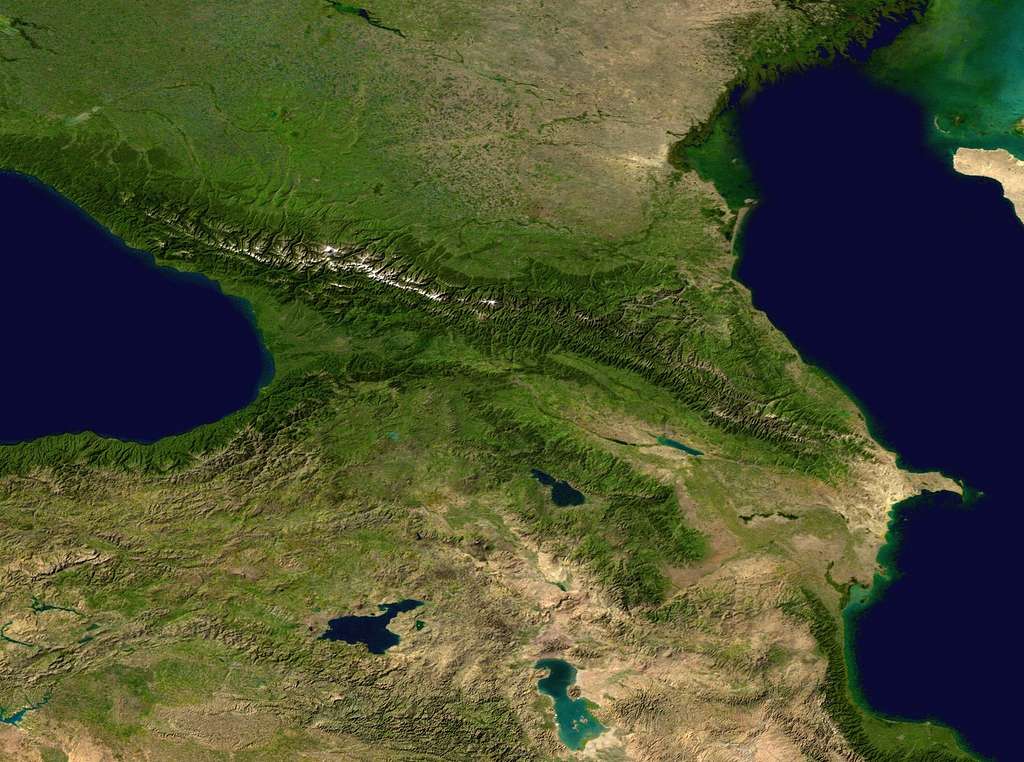
Photo source: NASA.
BACKGROUND: Each of the three South Caucasus countries—Armenia, Azerbaijan, and Georgia—has articulated distinct expectations regarding Trump's presidency. The Biden administration lacked a clear strategic vision for the South Caucasus, with Washington frequently oscillating between emphasizing human rights and democracy promotion (as exemplified by Georgia), and pursuing strategic calculations, such as swiftly signing a strategic partnership with Armenia to deepen the divide between Yerevan and Moscow. Washington's approach towards Azerbaijan similarly blended democratizing objectives with strategic considerations.
Under Biden’s administration, Georgia’s and Azerbaijan’s relations with the U.S. deteriorated, whereas Armenia, aiming to reduce its excessive reliance on Russia, benefited from Washington's policies between 2021 and 2024, culminating in the signing of a strategic partnership agreement in January. Consequently, all three states anticipate enhanced engagement from the Trump administration, with Azerbaijan and Georgia particularly expecting a significant shift toward greater transactionalism and realism in bilateral foreign relations.
Both Tbilisi and Baku have anticipated that under Trump their relations with the U.S. would improve. For example, Tbilisi supported the U.S.-backed UN resolution on Ukraine that diluted Russia’s responsibility for initiating the conflict. Similarly, Azerbaijani President Ilham Aliyev indicated in a statement that “…when President Trump led the U.S., our relationship developed very successfully—unlike the past four years, during which it significantly deteriorated owing to the Biden administration’s unfair and unjust stance toward Azerbaijan.”
IMPLICATIONS: A potential major agreement between the U.S. and Russia regarding Ukraine would likely affect the South Caucasus countries differently; however, the overall outcome may well be characterized by an expansion of Russian influence across the region.
Throughout Russia’s war in Ukraine, Moscow has faced significant challenges in maintaining its influence over the South Caucasus. Other powers, including China, Iran, Turkey, the Arab Gulf states, and even India, have expanded their presence in the region through substantial investments, trade agreements, and enhanced cooperation in security and energy sectors. This development has resulted in a period of regional multipolarity, where no single actor has been able to establish exclusive dominance. Consequently, Armenia, Azerbaijan, and Georgia have increasingly diversified their foreign policies, embracing a multi-vector approach beyond traditional partnerships.
Tbilisi and Yerevan have been notably successful in pursuing this strategy. For example, the Georgian government, while publicly maintaining its aspiration to join the EU, has concurrently signed a strategic partnership with China, enhanced cooperation with the Gulf Cooperation Council, and developed stable relations with Russia, despite the latter’s ongoing occupation of two Georgian regions. Armenia, aiming to reduce its reliance on Moscow, has sought increased military cooperation with India, explored the possible normalization of relations with Turkey, and, most significantly, announced its intention to seek EU membership.
Nevertheless, with a potential agreement on Ukraine, Russia would once again have the capacity to redirect resources into the South Caucasus to restore its weakened position. The Trump administration is unlikely to prioritize the smaller South Caucasus states, instead viewing the region primarily as within Russia’s sphere of influence. This approach aligns with Washington’s broader foreign policy objective of shifting its strategic focus toward the Indo-Pacific. Additionally, the U.S. lacks significant investments in the South Caucasus and shows limited interest in developing the Middle Corridor connecting Azerbaijan and Georgia to Central Asia.
More significantly, the South Caucasus states themselves increasingly perceive momentum shifting in the Kremlin’s favor and appear unlikely to oppose this declining trend. A potential agreement on Ukraine, which would solidify Russian gains, is expected to accelerate this shift toward Moscow. Indeed, Georgia and Azerbaijan have already anticipated such developments; what initially emerged as a policy of appeasement following Russia's invasion of Ukraine in 2022 has since evolved into a understanding that the balance of power in the region favors Russia. This shift partially reflects necessity, as Western powers were—and remain—unlikely to provide meaningful military assistance, while Russia continues to pose a credible threat despite its engagement in Ukraine.
Moreover, Georgia's approach reflects a deliberate foreign policy strategy implemented by the ruling Georgian Dream (GD) party, in power since 2012, aimed at developing a multi-vector diplomatic stance. Integral to this approach is the recognition of Russia's regional influence and a corresponding effort to maintain stable relations with Moscow. Although Georgia and Russia lack formal diplomatic relations, their bilateral economic ties have expanded considerably. Additionally, Tbilisi has subtly indicated declining enthusiasm for NATO and EU membership, both particularly contentious issues from Moscow's perspective.
In contrast, Baku possesses a considerably broader set of tools to counterbalance Russian influence, occasionally resulting in bilateral tensions, as exemplified by the recent incident involving a downed Azerbaijani aircraft. Nevertheless, geographical proximity, significant economic linkages, and Russia's formidable military presence will ultimately compel Azerbaijan toward reconciliation with Moscow. Indeed, signs of rapprochement are already evident through subtle gestures, such as the unveiling of a statue in Moscow honoring Heydar Aliyev, the father of current Azerbaijani President Ilham Aliyev, and Baku's hosting of the 22nd session of the bilateral inter-parliamentary commission.
Even in the case of Armenia, which signed a strategic partnership agreement with the U.S. shortly before Biden left office, it remains uncertain whether Washington will seriously commit to its implementation. Previous experiences are particularly instructive: between 2008 and 2024, Georgia maintained a strategic partnership agreement with the U.S., covering issues such as preparation for a free trade agreement, visa liberalization, and enhanced military and security collaboration. However, few tangible outcomes materialized, suggesting a similar pattern could emerge for Armenia. Early indicators are indeed discouraging, as evidenced by the reported postponement of a planned U.S. delegation visit to Yerevan. Additionally, Armenia's prospects for EU membership remain remote, given Georgia's ongoing difficulties with Brussels and internal disagreements within the EU regarding enlargement. Consequently, these factors will likely prompt Armenia to moderate its stance toward Russia, returning to full-scale cooperation even while maintaining certain aspects of its multi-vector foreign policy.
CONCLUSION: In the context of a potential rapprochement between Russia and the U.S. over Ukraine, the South Caucasus emerges as particularly vulnerable. Moscow would gain an opportunity to reassert its regional influence by filling the strategic vacuum left by an increasingly disengaged Washington. Additionally, Armenia, Azerbaijan, and Georgia are likely to recalibrate their foreign policies to align more closely with Russia. Although this trend has manifested in various forms over recent years, it is expected to accelerate significantly should Moscow successfully conclude its engagement in Ukraine.
AUTHOR BIO: Emil Avdaliani is a professor of international relations at the European University in Tbilisi, Georgia, and a scholar of Silk Roads. He can be reached on Twitter/X at @emilavdaliani.
Central Asia: An Opportunity for the Trump Administration

By Stephen Blank
March 22, 2017, the CACI Analyst
Central Asia has never ranked high on U.S. priorities. That is unlikely to change under the Trump Administration. Yet recent developments in Central Asia, particularly in Uzbekistan, do offer an opportunity to advance U.S. interests through a greater economic-political presence in the region, whilst also countering growing Chinese economic dominance and Russian efforts at military hegemony at a relatively low cost. The two key countries in this possible opportunity for the U.S. are Uzbekistan and Kazakhstan.
Advancing Georgian-U.S. security cooperation after the Trump transition

By Richard Weitz
January 19th 2017, the CACI Analyst
The Trump administration will soon undertake a comprehensive review of Russia-US relations and U.S. policy toward the rest of Eurasia. Although the new team will presumably consider many options, the president-elect’s statements imply that the U.S. will not soon support further NATO expansion or other actions that would strongly antagonize Moscow. Despite this limitation, the U.S. government will continue security ties with U.S. partners in Eurasia, such as Georgia. In practice, there are a number of steps the U.S. and Georgia can undertake to advance their mutual security.

Visit also