Political Battle For Armenia's Future Intensifies Ahead Of June Elections
By Laura Thornton
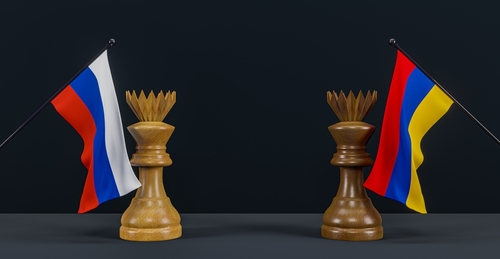
Armenians head to the polls on June 7 to elect all 101 members of parliament at a time of critical regional and geopolitical consequences. Following the 2018 Velvet Revolution and Nagorno-Karabakh war, the country has embarked on a new path of democratic reform and foreign policy alignments. Previously dependent on Russia for security guarantees and economic stability, the government of Prime Minister Nikol Pashinyan is now forging new ties with the European Union (EU) and United States, while redefining the country’s relationship with both Azerbaijan and Turkey. The election presents a choice beyond minor policy options but a vision for the country’s governance and geopolitical alignment. Given the stakes, both domestic and foreign actors have intensified their tactics, manipulating existing vulnerabilities, and present serious threats to the election process.
BACKGROUND:
The election is taking place at a historic pivot point for Armenia’s positioning in the region and beyond. Since the fall of the Soviet Union, Armenia has tied to Russia militarily, economically, and ideologically. Armenia has been part of the Eurasian Economic Union, a Russian initiative to ensure economic integration, and the Collective Security Treaty Organization (CSTO), a Russian-led security alliance. Russia has been Armenia’s largest supplier of military aid and key trading partner. Russia also owns key infrastructure in Armenia, including railways and telecommunications. However, Russia’s failure to defend Armenia during the 2020 and 2023 Nagorno-Karabakh conflicts damaged ties between the two states, with Yerevan suspending its participation in the CSTO and demanding the removal of Russian border troops.
While turning away from Russia, the government has pursued European Union (EU) accession and signed a framework to implement the Trump Route for International Peace and Prosperity (TRIPP), which aims to establish a transit route in the south Caucasus. Further, regional calculations have dramatically changed, paving the way for a redefined relationship with both Azerbaijan and Turkey, with a peace agreement being formed with the former and new border and trade discussions with the latter.
Two main opposition blocs, which are closely tied to Russia, are challenging the ruling Civil Contract party of Pashinyan. The ruling party is running on “peace,” which it defines as continuing the negotiations with Azerbaijan and building closer ties with the EU and U.S. The opposition blocs oppose the government’s peace agreement, accuse the government of being under Azerbaijani and Turkish control, and say EU goals are unrealistic.
While the political contest does not fall along neat “pro-West vs. pro-Russian” divides as in some frontline democracies, and none of the viable parties embraces a full break from Russia (mindful that the plurality of Armenians believe Russia is the country’s most important political partner), the parties do differ significantly on the nature of the relationship. The Kremlin has taken note and activated its hybrid warfare playbook, employed in Georgia, Moldova, and other democracies, to defeat the ruling party.
The political landscape is also shaped by a fierce conflict between the government and Church leaders. Church leaders – headed by Karekin II, the Supreme Patriarch and Catholicos of All Armenians – accuse the Pashinyan government of “losing” the war in Nagorno-Karabakh and have called for the Prime Minister’s resignation. In turn, the government has prosecuted several bishops on charges ranging from “calling for a coup” to drug charges, prosecutions which many independent groups believe lack strong evidence. Opposition parties have seized on this issue, criticizing the government and defending the Church.
IMPLICATIONS:
Given the partisan divergence on the country’s foreign policy orientation, the geopolitical stakes in the election are high, activating malign actors. The Kremlin sees clearly the threat of the ruling Civil Contract, which has pledged more decoupling from Russia and greater alignment with Europe and the U.S. While recently on a pre-election assessment mission to Yerevan, government officials, civil society representatives, diplomats, and observers described Russia’s hybrid warfare in the country as “unprecedented.” There was also widespread agreement that the country was not adequately prepared for the threat, made worse by the elimination of USAID and its support in bolstering the country’s defenses.
Information is central to the Kremlin’s strategy. Russia dominates the airwaves, with Russian channels freely broadcast on national television, and social media, where there are few regulations. Narratives focus on Armenia’s need for Russian security, and how the Pashinyan government has ceded sovereignty to Azerbaijan, and for the Russian market. Emphasis is on Armenia as part of Russia’s sphere of influence. Disinformation about elections, institutions, and democracy is prevalent, particularly sowing distrust in the integrity of the upcoming election. Russian information campaigns bolster opposition talking points, such as those accusing the government of suppressing speech and political prosecutions.
The Kremlin has infiltrated charities, movements, and foundations, such as the “Foundation to Battle Injustice,” established by the late Wagner Head Yevgeniy Prigozhin. Russia and Armenian Church leaders are also in lockstep, each amplifying the other’s attacks on the government, messaging on traditional values, and criticism of Western institutions. Russia has also mobilized the Armenian diaspora to vote in previous elections, paying for transport and vote buying. Russian banks and businesses operate throughout the country making financing of influence operations and proxies easy.
It is widely acknowledged in Yerevan that the country is not adequately prepared to defend against this threat. Government bodies are poorly resourced and often lack the mandate, technology, and tools to investigate or conduct counter efforts. There are also legal loopholes, such as the lack of regulation on third parties, which frequently engage in political activity. Civil society groups, research institutes, and independent media – central to building resilience to hybrid threats – are also poorly resourced, particularly since the elimination of USAID.
Electoral victory for the main opposition blocs, the beneficiaries of Russian influence, would signify a reversal on the country’s current trajectory. Russian citizen Samvel Karapetyan, owner of the Russian Tashir Group, founded the opposition Strong Armenia. The other main opposition bloc, Armenia Alliance, is led by former President Robert Kocharyan who serves on the board of directors for Sistema PJSFC, one of Russia’s largest investment companies. In addition to their obvious Russian ties, the parties reject Pashinyan’s peace agreement (and do not offer a clear alternative), do not approve of TRIPP, and believe Armenia is “not ready” for the EU.
According to recent polling, Civil Contract is polling at 24 percent, Strong Armenia at nine percent, and everyone else below the threshold. This polling also shows the majority of support for the ruling party comes from older (56+) and more urban citizens. Importantly, those who select Civil Contract are far more likely to identify as “pro-Western” (73 percent) while those who support Strong Armenia believe the country’s policy should be “pro-Russian” (71 percent).
CONCLUSIONS:
Armenia’s election could lead to the continuation of the country’s new foreign alignment course, forging new economic and security relationships and exerting greater freedom from Russian control. Alternatively, the country could abandon this direction, taking a closer path to that of neighboring Georgia, which has alienated the West and forged closer ties with Russia, China, and Iran. At a time of upheaval and uncertainty in the region, a strong alliance of pro-Russian governments along the vertical axis from Moscow to Tehran would have significant consequences. It could block Western interests in and access to the region and beyond, lead to new destabilization between Armenia and Azerbaijan, and embolden Russia to act elsewhere.
Enhanced U.S. and European support would help fortify the elections from malign actors through increased technical assistance, intelligence, financing, and training to Armenian partners.
AUTHOR’S BIO:
Laura Thornton has spent more than 30 years in the democracy, governance, and security space both as a practitioner and policy and advocacy expert. She lived more than two decades in Asia and the former Soviet Union and has held positions at the McCain Institute, the German Marshall Fund, International IDEA, and the National Democratic Institute.
Georgia’s October 26th Parliamentary Election: What’s at stake and what do we expect?
By Pauline Le Grand
This Saturday, on October 26th, Georgia, will decide its future trajectory in parliamentary elections. The country stands at a crossroads and must decide whether to continue towards a European future or turn towards authoritarianism. After achieving candidate status for the European Union in 2023, the passing of the “foreign agent” law by the ruling Georgian Dream (GD) party raised concerns over the country’s democratic progression and stalled its EU ascension. The GD remains a strong contender for this election, especially in Georgia’s more conservative regions, and risks steering Georgia away from the EU for good. This election will not only test the resilience of Georgia’s democratic institutions but will also reveal the country’s broader geopolitical alignment in an increasingly polarized region.

BACKGROUND: On October 26th, Georgians will head to the polls to decide their future. This election is one of the most significant in Georgia's history as it will determine whether Georgia will remain on its European path or succumb to the Kremlin's sphere of influence. In December 2023, Georgia was granted candidate status for the European Union on the understanding that the country would work to make significant changes towards accession. Yet, since then, Georgia appears to have done just the opposite and its accession process has been frozen. In April 2024, the current government, led by the Georgian Dream (GD) party, passed the law on transparency of foreign influence, referred to as a copy-paste of Russia's foreign agent law. Civil society organizations (CSOs) receiving more than 20 percent of funds from overseas had to register on the Government's list as they were deemed to be carrying out the interests of a foreign power. The bill was first proposed in 2023 but withdrawn due to popular discontent. This year, despite promising to not revisit the law, despite even fiercer popular opposition gathering thousands of Tbilisi citizens in front of Parliament for weeks, and despite pro-European President Salome Zurabishvili's veto, the government adopted the bill on May 28th. Of an estimated 300,000 CSOs in Georgia, only 476 CSOs registered, with the others ignoring the law in protest. They preferred to wait for the government's investigation and resulting hefty fines with the hope that the upcoming election will lead to a reevaluation of the bill. The government also passed an anti-LGBTQ+ propaganda law in September as part of a legislative package 'On Protection of Family Values and Minors'. The law is a clear violation of freedom of expression and assembly. The Georgian Dream party has promised that if re-elected, it will effectively ban all opposition groups and turn Georgia into a single-party state. The GD, backed by billionaire Bidzina Ivanishvili, has been in power for the last twelve years and is determined to maintain its hold of the government. Despite the GD's apparent authoritarian turn and seeming unpopularity, it is projected to obtain a significant percentage of the vote. The question is whether it will secure enough votes for a supermajority, which would enable it to amend the constitution freely, distancing Georgia further from democracy and ultimately from the European Union.
IMPLICATIONS: In early October, the Georgian Dream launched an incredibly successful poster campaign across the country. While the capital of Georgia is relatively progressive and anti-GD, 70 percent of voters are registered outside the capital. Regional voters are overall less critical of the current government, focused on issues of employment and wages, stability and peace, and are generally culturally conservative. Regional voters have higher turnout and are therefore key to the outcome of the election and to Georgian Dream's constitutional super-majority (3/4 of Parliament).
The Georgian Dream (GD) party's rise to power was viewed by some as a positive turning point for Georgia. The party successfully ousted former President Mikheil Saakashvili, who had come to power following the 2003 Rose Revolution. Initially, Saakashvili's leadership brought significant improvements, including the removal of a corrupt elite, implementation of free-market reforms, and impressive economic growth. However, towards the end of his tenure, Saakashvili and his United National Movement (UNM) party tightened control over the political system, allowed elite corruption to spread, and expanded law enforcement powers excessively. Many felt that Saakashvili and the UNM had implemented changes too rapidly and aggressively. In contrast, GD's early years saw improvements in human rights and media freedom, along with a reduction in heavy-handed law enforcement. The party continues to benefit from lingering discontent with the Saakashvili era and fear of its potential return. GD has also cultivated support through social welfare programs, particularly pensions. Many voters worry these benefits might disappear if they don't support the ruling party. This fear is particularly pronounced in areas where electronic voting is being introduced, as some voters believe the new system compromises ballot secrecy, leading to pressure to vote for GD.
Fear remains a central and effective theme in Georgian Dream's (GD) election strategy. The mere possibility of losing pensions is often enough to drive voters to support GD. Similarly, the prospect of the United National Movement's (UNM) return motivates some Georgians to cast their ballots this Saturday. The UNM is inextricably linked to memories and fears of war.
Under Saakashvili's leadership in 2008, Russia invaded South Ossetia, a territory beginning just 40 kilometers from the capital. The 1992-1993 war with Abkhazia also lingers in the collective Georgian memory. Russia's 2022 invasion of Ukraine reignited these concerns for Georgians, who strongly support Ukraine. The fear of another conflict weighs heavily on the minds of Georgians, particularly older voters who constitute the majority of the electorate – a fear GD has not hesitated to exploit.
A week after its initial poster campaign, GD launched a new series depicting Ukrainian buildings destroyed by Russian bombs alongside intact Georgian structures. This campaign sparked online outrage, with Georgian President Salome Zurabishvili commenting on Facebook: "How desperate and pitiful must you be to shamelessly and brazenly offer your people a poster crafted in the 'forges of the KGB'! 'With dignity' towards hell!" Nevertheless, GD's message remains potent; they warn that a vote for the opposition is a vote for war. Ivanishvili even suggested apologizing to South Ossetia for the 2008 war, which he blamed on Saakashvili's government. GD also hints at the possibility of reconciliation between Georgia, Abkhazia, and South Ossetia with Russian assistance.
GD's successful fear campaigns stand in stark contrast to the opposition's apparent weaknesses. No single party emerges as particularly strong. Fragmented across four different coalitions, none offers a promising alternative. The opposition lacks connection with the regions; once outside Tbilisi, the already scarce opposition campaign posters virtually disappear. In some areas, voters have never even heard of certain opposition parties. Even in Tbilisi, those inclined to vote against GD struggle to choose a party, uncertain which might garner more votes.
CONCLUSION: This weekend's election will undoubtedly be a pivotal moment for Georgia's foreign policy orientation and liberal democracy, both within Georgia and more broadly. With a high risk of external interference, particularly from Russia, the stakes are high. Moldova's close call last weekend in the EU referendum serves as a reminder of the fragility of democracy and regional tendencies towards illiberalism. Still, the hope remains that Georgia's path will continue to align with Europe and the West, reflecting the population's overwhelming desire to join the European Union. Georgia is caught between an older population that remembers with great fear these two wars and is willing to back down to Russia and a politically active younger population who dreams of a liberal and European future. October 26th will show the rest of the world which pull is stronger today in Georgia.
AUTHOR'S BIO: Pauline Le Grand is a research intern at the Rondeli Foundation in Tbilisi, Georgia, where she researches Russia's influence in Ukraine, Central Asia and the Caucasus.
Kazakhstan Elects New President
By Natalia Konarzewska
June 18, 2019, the CACI Analyst
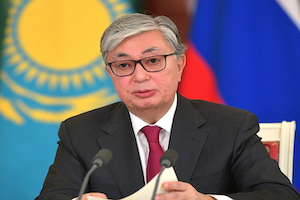
On June 9, 2019, Kazakhstan held snap presidential elections following the resignation of long-term President Nursultan Nazarbayev. Nazarbayev’s close associate and former speaker of the Senate Kassym-Jomart Tokayev won the ballot receiving 70.76 percent of the votes. The election was accompanied by large protests in the country’s capital Nur-Sultan and in Almaty, followed by detentions of hundreds of protesters. It is unlikely that the change of president will bring radical change in Kazakhstan. Tokayev has already declared his commitment to preserving Nazarbayev’s legacy. Multiple developments indicate that preparations for the power shift in Kazakhstan have been ongoing for years, suggesting that the presidential succession was carefully planned and micromanaged from behind the scenes to ensure a smooth transition of power.
Georgian Politics in Anticipation of the 2020 Parliamentary
By Casper Wuite
May 28, 2019, the CACI Analyst
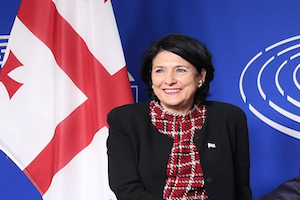
Only six months after a closely fought presidential election, Georgia’s political forces are repositioning themselves for the 2020 parliamentary elections. With Georgian Dream’s popularity waning – the party won landslides in previous votes – the party may need support from conservative and ultra-nationalist political parties in order to form a majority government after 2020. The international community, concerned about the rise of pro-Russian and nationalist sentiment, will keenly watch the 2020 elections to see in which direction the country, and its process of democratization and Euro-Atlantic and European Integration, is heading.
Why Kazakhstan's Presidential Elections Matter
By Rafis Abazov
May 23, 2019, the CACI Analyst
The resignation of Kazakhstan’s President Nursultan Nazarbayev in spring 2019, after 30 years of uninterrupted stewardship, had an unexpected timing. However, even more unexpected was the Parliament of Kazakhstan’s hastily announced early presidential elections scheduled for June 9, 2019. Even some major political insiders were caught unprepared. Indeed, leading local analyst Sergei Domnin of Expert Magazine wrote that the entire political establishment woke up to find Kazakhstan at a political “crossroad.” Some believe that the elections are just a face change and that the ruling elite will continue to pursue the same policies. Others claim that the elections could lead to the emergence of an “entirely new political model.”
Visit also