Georgia’s Democratic Reversal: The Danger of an Unquestioned Consensus
By Ambassador David Dondua
Georgia’s democratic backslide has shocked observers at home and abroad. Once a “beacon of democracy” and a frontrunner of European integration, the country has lost its standing within the European democratic family in a remarkably short time. While this shift may appear sudden, it reflects deeper vulnerabilities—lessons that matter not only for Georgia but also for other small states navigating similar geopolitical crossroads.
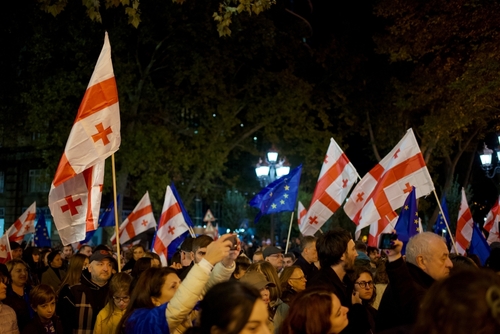
BACKGROUND:
The rapid erosion of Georgia’s democratic and pro-Western trajectory cannot be explained by a single decision, policy, or political figure. Rather, it is the result of a complex combination of factors. At the most general level, it reflects the success of a long-term Russian hybrid and cognitive operation against Georgian society, an operation that ultimately proved much more effective than the 2008 military invasion.
As a result of the August 2008 Russo-Georgian war, Russia occupied only 20 per cent of Georgia’s territory. In the decade that followed, however, Moscow achieved something far more consequential. Through sustained political influence, economic leverage, disinformation, and elite capture, it gradually penetrated Georgia’s state institutions. Government, parliament, the presidential administration, courts, security services, police, armed forces, and the foreign service all became vulnerable to influence. Most importantly, Russia succeeded in distracting the country from its European integration trajectory and sowing mistrust toward democratic reforms and Western aspirations. Strategically, this amounted to the cognitive occupation of the entire state.
Blaming this reversal solely on Russian hybrid attacks, the pro-Russian stance of the ruling Georgian Dream government, or the role of the de facto ruler, billionaire Bidzina Ivanishvili, would be too simple. The reality is more complex. Among the many political, social, and institutional factors that shaped Georgia’s vulnerability, one has remained largely unrecognized, rarely discussed, and almost entirely absent from public debate.
In the late 1980s, as the collapse of the Soviet Union became inevitable, Georgian society engaged in intense debates about the future of the independent state. Constitutional arrangements, models of governance, economic systems, currency, and even sporting affiliations were openly discussed. One issue, however, was never truly debated: the foreign policy orientation of independent Georgia.
On this question, there appeared to be complete consensus. Becoming part of the West was treated as self-evident—almost sacred. It was widely perceived as the fulfilment of centuries-long aspirations to align Georgia with Europe. No alternatives were discussed, not because they were examined and rejected, but because few dared to articulate them. In a diverse, multi-ethnic society that had lived under Russian rule for more than two centuries, it is unlikely that such alternatives were entirely absent. Yet for the next three decades, this unchallenged consensus shaped both Georgia’s foreign and domestic policy.
IMPLICATIONS:
From today’s perspective, this unquestioned consensus appears to have been a missed opportunity for deeper and informed societal consolidation. This observation should not be misunderstood as questioning Georgia’s European choice. The author firmly believes that the European path was and remains the right choice for Georgia. Yet accepting this choice without deep public reasoning, open discussion, or even heated debate left society ill-prepared to fully understand and defend it.
Georgian society is often characterized by emotional radicalism, reinforced by a lack of democratic traditions. This leaves limited space for critical reflection. As a result, key aspects of EU and NATO integration were rarely discussed in a fact-based and accessible way. Public support, therefore, remained largely emotional rather than knowledge-based.
This gap became visible whenever misinformation spread. Claims that EU regulations would ban or severely restrict traditional agricultural products, force the uprooting of vineyards—widely perceived as an attack on Georgia’s cultural heritage—or exclude most of local goods from European markets due to strict quality standards repeatedly triggered public outrage. Such narratives exposed how shallow public understanding often was, despite consistently high levels of declared support for European integration.
Insufficient effort was made to explain to citizens that compromise is inherent in joining any international organisation. Government officials and even NGOs promoting the EU and NATO integration often avoided discussing trade-offs and long-term costs. Citizens were rarely told that today’s difficulties are frequently the price of tomorrow’s benefits—choices that can only be made consciously by an informed society.
Following the adoption of the Deep and Comprehensive Free Trade Area (DCFTA), the state should have launched a large-scale educational effort to demonstrate how this instrument could be applied in practice, particularly for small entrepreneurs and rural communities. While some initiatives were undertaken, largely with donor support, they were insufficient. For many citizens, European integration remained an abstract promise rather than a lived experience.
A fundamental contradiction of Georgia’s post-independence politics is that all Georgian governments over the past three and a half decades have claimed to be pro-Western and have promised the population a European democratic future, including NATO membership. Even the current ruling party, Georgian Dream, publicly declared the same until recently. Yet in practice, the actions of all those governments, without exception, have often fallen short of democratic standards, at times even sharply contradicting them.
Against this backdrop, today, the ruling party has deliberately cast Europe as a convenient scapegoat for almost all of the country’s past and current difficulties, whether stemming from poor governance, institutional weaknesses, corruption, reform costs, or external developments beyond Georgia’s control. Georgian Dream has transformed ordinary challenges into a political weapon to erode public trust in democratic reforms and derail the country’s European path.
As noted above, in every election, including the watershed 2012 vote, virtually all political actors pledged a European future to voters; even marginal candidates openly backed or courted by the Kremlin used pro-Western rhetoric. Unlike in Ukraine, Moldova, or Armenia, where societies were exposed to competing geopolitical visions and, over time, could observe different policy orientations, compare outcomes, and distinguish between credible and non-credible strategic paths, Georgian voters were never offered a genuine choice. They were offered reassurance that the European path was uncontested and secure. This monopoly of a single geopolitical orientation meant that alternatives were neither seriously articulated nor openly debated. Paradoxically, the absence of pluralism later became a vulnerability: because the European choice was never collectively debated and consciously affirmed, it failed to generate a strong sense of public ownership.
Today, pro-Russian actors exploit this gap by asking: “Who decided that Georgia must choose Europe?” The ruling Georgian Dream has increasingly reinforced this narrative by claiming that the European course was imposed on Georgia by some phantom foreign forces.
At the same time, fully replacing Europe with Russia remains politically tricky in the short term, given prevailing public attitudes. Instead, the government has sought to cultivate the idea of “state neutrality” as an ostensibly safer alternative to Western integration, one that promises stability while allowing Georgians to preserve their traditions, identity, and way of life without external pressure. Packaged in this way, neutrality appears as a return to normalcy and sovereignty. Such a narrative can gain traction precisely because the European path was never thoroughly debated, internalised, and embraced on the basis of knowledge.
In reality, however, neutrality functions as a transitional narrative rather than a genuine option. Given Georgia’s geography, security environment and economic dependencies, let alone historical experience, neutrality is simply not workable. In practice, abandoning Western integration is the fastest route to renewed subordination to Russia and the gradual erosion of Georgian statehood.
CONCLUSIONS: Georgia’s democratic and geopolitical setback is not the result of abandoning Europe overnight. It is the consequence of failing to cultivate deep understanding, ownership, and resilience around the European choice over three decades. Strategic orientations cannot survive on consensus alone; they require constant explanation, public debate, and civic education.
For years, Georgia proudly cited overwhelming public support for European integration. Yet emotional endorsement without understanding is fragile. A society that genuinely comprehends how Western institutions function and what integration realistically entails is far more resilient to manipulation. In retrospect, 50 or even 40 per cent of firm, knowledge-based support would have been more durable than 80 per cent of symbolic approval. This underscores that the key to Georgia’s recovery lies not in numbers alone but in cultivating genuine understanding and ownership among citizens.
This moment, however, is not irreversible. What was insufficiently addressed in the past can still be corrected. Periods of crisis often force societies to replace inherited assumptions with conscious choices. Continued engagement by Georgia’s Western partners is therefore essential—not less, but more focused on education, communication, and societal resilience.
Europe has not disappeared from Georgia’s collective identity. If reinforced through knowledge rather than slogans, it can still serve as the foundation for democratic recovery and a sustainable return to the European path.
AUTHOR’S BIO: Ambassador David Dondua is a diplomat and political analyst. He serves as Chairman of the EU Awareness Centre, a Brussels-based think tank focused on European integration, democratic resilience, and countering hybrid threats in Eastern Europe and the South Caucasus.
The Eurasian Economic Union – Implications for Governance, Democracy and Human Rights

By Daniel Linotte (12/10/2014 issue of the CACI Analyst)
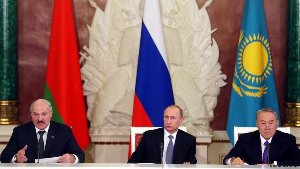
In January 2015, a new regional agreement will enter into force between Belarus, Kazakhstan and Russia – it will create the so-called Eurasian Economic Union (EEU), replacing the Eurasian Economic Community (EEC) established in 2006. Taking into account actual trade flows and national economies, the EEU can hardly be justified and should not have much impact on economic integration among its members. Nevertheless, Western countries should still be worried about possible non-economic consequences of the new agreement, especially for governance, democracy and human rights, in countries that are already displaying authoritarian tendencies.
PACE's New Resolution Criticizes the Georgian Government
By Eka Janashia (15/10/2014 issue of the CACI Analyst)
The Parliamentary Assembly of the Council of Europe’s (PACE) October 1st resolution on “the functioning of democratic institutions in Georgia” spurred debates in both Strasbourg and Tbilisi.
The Georgian Dream ruling coalition along with Michael Aastrup Jensen of Denmark and Boriss Cilevičs of Latvia, the two PACE co-rapporteurs on Georgia, strongly opposed the document while the United National Movement (UNM) opposition party supported it, backed by the majority of Assembly members.
The draft resolution built on a report prepared by the co-rapporteurs as a part of PACE’s regular activity to observe the country’s performance regarding obligations undertaken upon its accession to the Council of Europe (CoE) in 1999.
Allegedly, UNM members of the Georgian delegation were, through the support of European People’s Party (EPP), able to introduce amendments to the initial version in order to make it more critical of the Georgian authorities. As a result, the originally “balanced” report has been changed into a “partisan” one, Jensen and Cilevičs claimed. Jensen termed the product “completely a shame,” because PACE should not be taking sides in Georgia’s internal politics, but should instead “try to paint a picture as correctly as it is.”
According to the document, despite the peaceful handover of power after the 2012 parliamentary and 2013 presidential elections in Georgia, the arrest and prosecution of almost the entire UNM leadership “overshadowed” the democratic achievements the country has made since.
The document describes the detention in absentia of former President Mikheil Saakashvili, former Minister of Defense David Kezerashvili and former Minister of Justice Zurab Adeishvili as well as the arrest of former Prime Minister and UNM Secretary General Vano Merabishvili, former Defense Minister Bacho Akhalaia and former Tbilisi Mayor Gigi Ugulava as regressive moves for Georgia’s democracy.
The resolution expresses concerns over the freezing of assets belonging to former government officials’ family members and the length of Akhalaia’s pre-trail detention, asking the authorities to replace detention on remand with non-custodial precautionary measures. It takes note of the multiple charges filed against the former president as well as the large number of possible instances of criminal conduct on the part of former government officials and emphasizes that no one is above law, but meanwhile urges the authorities to ensure that their trials are impartial.
In this respect, the resolution recalls the Assembly’s reservations regarding the independence of the judiciary and administration of justice in Georgia. While it welcomes positive signals such as the adoption of a comprehensive reform package aiming to establish a truly adversarial justice system, it also notices that the sensitive legal cases against opposition leaders has disclosed “vulnerabilities and deficiencies” of the system. Thus, the Assembly suggests further reforms of the judiciary and prosecution service and recommends the Georgian parliament to achieve a necessary compromise to elect all members of the High Council of Justice.
Another set of concerns refers to an increasingly intolerant and discriminatory attitude especially towards sexual and religious minorities and a lack of measures from all stakeholders – the investigative and prosecution agencies, politicians and institutions with high moral credibility – to examine “hate crimes” and condemn discriminatory sentiments. Regarding minorities, the Assembly also calls on the Georgian authorities to sign and ratify the European charter of regional and minority languages, which remains an unfulfilled commitment of the country since its accession to CoE. The Assembly recommends the government to communicate the charter’s provisions to the public through an awareness campaign and ensure the engagement of civil society, media and other interest groups in the process. As for the deported Meskhetian population, the document underscores the setbacks in granting citizenship to already repatriated persons.
Before the resolution was adopted, PM Irakli Gharibashvili expressed hope that EPP along with other members would not rely on the “groundless allegations” put forward by UNM. Later, commenting the already approved document, he said the amendments to the resolution had been passed because of EPP’s “solidarity” with UNM. “The wording that was made in reference to Akhalaia and Saakashvili – I do not deem it alarming. This is yet another attempt by the UNM to fight against its own state, its own people,” he said.
Although the Assembly is deeply concerned about “a polarized and antagonistic political climate” in Georgia, the resolution has further fanned the confrontation between GD and UNM. Rejecting political motivations, GD declares that prosecution of former officials is a demand of Georgian people and that it certainly should be met. The head of the human rights committee in the Georgian parliament and one of the GD leaders, Eka Beselia, termed the Assembly’s request regarding Akhalaia an attempt to exercise pressure on the independent court.
The adoption of a critical resolution on Georgia signifies that leading European political forces are principally against the marginalization and demonization of UNM, as its disappearance from political scene would enormously damage democratic processes in the country. On the other hand, GD evidently maintains a tough approach reflected in its indifference to the PACE recommendations regarding the prosecution of opposition party members.
Azerbaijan Increases Pressure on Civil Society
By Mina Muradova (10/01/2014 issue of the CACI Analyst)
Whereas Azerbaijan’s President Ilham Aliyev intensively uses social media platforms for promoting Azerbaijan as a prosperous and democratic country, human rights observers condemn the authorities of this post-Soviet country for a recent escalation of repression against civil society activists.
“A free society has emerged in Azerbaijan. All democratic institutions are available and they operate successfully,” – @presidentaz, the official account of President Aliyev tweeted in early September. In a minute, another tweet said, “All freedoms, including the freedom of speech, the freedom of conscience, the freedom of the press and free Internet, are available.” And later, “Azerbaijani society is a free society, and this is our great achievement.”
The regional analyst and blogger Arzu Geybullayeva said that for anyone familiar with Azerbaijani realities, “the presidential feed is bitterly ironic, if at times darkly entertaining … Elsewhere in the post-Soviet world, authoritarians have figured out that succinct means success in social media. But Aliyev’s feed reads like one long speech regularly interrupted by a pesky 140 character limit,” she wrote on GlobalVoices, a citizen media platform.
The reason for Geybullayeva’s concern is the fact that the number of politically motivated detentions has increased sharply in the country after the defeat of a Parliamentary Assembly of the Council of Europe (PACE) resolution on “The follow-up to the issue of political prisoners in Azerbaijan” on January 26, 2013. Amnesty International has recognized 24 people as “prisoners of conscience” in Azerbaijan, who were “jailed solely for peacefully exercising their right to freedom of expression” in recent months.
The latest in a series of attempts to silence government critics is the case of journalist and human rights defender Ilgar Nasibov, who was found unconscious with severe head trauma and broken bones in his face, in late August. “He was called from home to go the office in the evening,” his wife Malahat Nasibova told Azadliq radio. “They said some petitioners had come. They attacked him suddenly in the office and inflicted numerous injuries.” Unidentified people stormed the office of the Democracy and NGO Development Resource Centre in the Nakhchivan exclave of Azerbaijan, which he heads. Amnesty International reported that the Nasibov couple has long faced regular intimidation because government officials want them to leave the region, as they are “the only remaining independent voices there.” Even though the authorities reportedly detained one of Nasibov’s assailants, they have not initiated a criminal investigation.
Among the total number of politically motivated arrests, more than ten members of the media and bloggers are behind bars or awaiting trial. It is the highest number that the Office of the OSCE Representative on Freedom of the Media has observed in Azerbaijan since the office was established. The OSCE’s representative Dunja Mijatović called the government of Azerbaijan to stop “the continued persecution of media and free voices in the country.” According to Mijatović, “These cases and accompanying smear campaigns have resulted in worrying setbacks for the development of free expression in Azerbaijan that create a chilling effect on media and society as a whole … While I do not challenge the lawful right of the authorities to scrutinize the activities of non-governmental organizations, such actions should not be aimed at silencing critical voices.”
On September 15, local media published a letter from prominent human rights activist Leyla Yunus to her husband Arif Yunus. The couple are kept in different pre-trial detention centers. She compared the political climate in contemporary Azerbaijan with the massive political repressions in the Soviet Union orchestrated by Joseph Stalin. “They began to arrest whole families, as Stalin did. The tyrant behaves as if there is no CE or EU or other international organizations,” she stated. Yunus reported that her cellmate verbally harassed her and threatened “to break her arms and legs” immediately after Yunus had met with representatives of the UN Commission against Torture in the Kurdakhani prison.
Three days later, the European Parliament (EP) called on Azerbaijan to undertake “long-overdue human rights reforms without further delay and cease their harassment of civil society organizations, opposition politicians and independent journalists and lift the ban of public gatherings in Baku.” Members of the EP condemned “in the strongest possible terms” the arrest and detention of human rights activists and demanded their “immediate and unconditional” release.
The Azerbaijani leadership continues to brush off any allegations that it is behind the serial arrests of its critics and the closure of their organizations. “It is regrettable that these NGOs and individuals – and some journalists – fall back on the foreign forces that fund them and regard themselves as above national law, refusing to report their grant-funded projects, file accounts, pay their taxes and comply with other legal requirements set out by the government,” Ali Hasanov, political affairs chief in the presidential administration, told the AzerTag news agency. “In those circles, the appropriate actions that state institutions have taken are sadly being misrepresented as ‘pressure on civil society’ and as ‘restrictions’ on the functioning of NGOs and the media. It’s a campaign to blacken Azerbaijan’s reputation.”
The Georgian Orthodox Church and its Involvement in National Politics

By Carolin Funke (08/14/2014 issue of the CACI Analyst)
After the dissolution of the Soviet Union, the Georgian Orthodox Church (GOC) emerged as Georgia’s most respected and influential institution. It has played a significant role in the Georgian public sphere ever since and enjoys a high level of trust among the Georgian population. But as Georgia moves towards Euro-Atlantic integration, the GOC increasingly appears to develop into a political force. Recent statements by the clergy on Georgia’s municipal elections and the GOC’s active involvement against law-making and political processes intended to strengthen social and political pluralism raise concerns over its role in Georgia’s democratic development.
Visit also