Armenia Seeks to Reduce Russia's Monopoly on Railway Infrastructure
By Vali Kaleji
While the Armenian government appears to seek a short-term balance between the U.S. and Russia in the railway sector, its long-term objective is to end Russia’s monopoly and extensive influence over this critical infrastructure in Armenia. The realization of this objective, as well as reforms in the electricity and gas sectors, largely depends on the outcome of the decisive parliamentary elections on June 7, 2026. These elections will determine whether Armenia returns to its pre-2018 foreign policy orientation or continues its recent trajectory toward closer alignment with the West.

Photo by Denis Belitsky, 2023
BACKGROUND:
On 13 February 2008, Armenia signed an agreement transferring full control of the state-owned Armenian Railways to South Caucasus Railway (Yuzhno-Kavkazskaya zheleznaya doroga, YuKZhD), a wholly owned subsidiary of Russian Railways (RZhD). Subject to mutual agreement, the contract may be extended until 2048. The agreement followed a concession model, transferring operational, managerial, and investment responsibilities to the Russian side. Although ownership of the railway infrastructure formally remained with the Armenian government, operational control, investment decisions, tariff policy, and network development were effectively placed under Russian authority, constituting influence without formal ownership.
The 2008 railway agreement was effectively a continuation, and one of the consequences, of the 2002–2003 “debt-for-assets” agreement between Armenia and Russia, which settled Armenia’s US$ 96 million debt to Russia. The 30-year concession agreement is widely regarded as a major turning point in the development of Russia’s structural influence over Armenia’s economy and infrastructure in the post-Soviet period. Under the debt-for-assets arrangement, ownership or management of six major industrial and economic assets in Armenia, including electricity, gas, electronics, and defense-related sectors, was transferred to Russia, facilitating Russian dominance and influence in other sectors, including railways and telecommunications.
To reduce this monopoly and dependency, the Armenian government signed an agreement with Iran in 2009, one year after the 30-year concession agreement, to construct the “Marand–Norooz–Meghri–Yerevan” railway. Russia opposedthe project, and despite considerable efforts by Armenia, the railway was never realized, leaving Russia’s monopoly over Armenia’s railway network intact.
Plans to revive Soviet-era railway routes in the southern South Caucasus failed to materialize in the transformed regional environment following the Second Nagorno-Karabakh War in 2020. However, the peace agreement signed by Ilham Aliyev and Nikol Pashinyan at the White House on August 8, 2025, marked a new phase in the construction and integration of road and railway routes in southern Armenia. Nevertheless, despite the completion of approximately 80 percent of the 110-kilometer Horadiz–Aghband railway line in southwestern Azerbaijan (around 140 kilometers including auxiliary routes), and Turkey’s initiation of a new 224-kilometer railway line from Kars to the Nakhichevan border, scheduled for completion before 2030, the rehabilitation and construction of the railway line in southern Armenia has yet to begin.
In these circumstances, during a press briefing on February 13, Armenian Prime Minister Nikol Pashinyan stated that a country maintaining “friendly relations” with both Russia and Armenia could “purchase the concession management rights” of Armenia’s railways, which are currently under Russian management. He presented this as a potential solution to Armenia’s loss of “competitive advantage” by having international routes pass through the country. When asked which states could assume such a role, Pashinyan mentioned Kazakhstan, the UAE, and Qatar, while noting that the list was not exhaustive.
IMPLICATIONS:
Pashinyan’s recent statements may represent the latest step by the Armenian government to reduce the country’s dependence on Russia in the infrastructure sector. Following the collapse of the Soviet Union, Russian control and influence over Armenia’s railway network and railway management became particularly significant due to Armenia’s status as a landlocked country. After the First Nagorno-Karabakh War, Armenia’s railway routes with Azerbaijan (the eastern route) and Turkey (the western route) were closed. The disruption of railway connections between Armenia and Azerbaijan also severed Armenia’s rail link with Iran via the Julfa–Nakhichevan route. Consequently, over the past three decades, Armenia’s only active railway connection has been the northern route, a Soviet-era railway line running through Georgia to Russia and the Black Sea. Notably, despite the breakdown of diplomatic relations between Russia and Georgia following the August 2008 war, this railway corridor, like the road route, has remained open and operational.
The absence of Armenia’s railway connectivity in three directions, eastward towards Azerbaijan, southward towards Iran, and westward towards Nakhichevan and Turkey, and the country’s dependence on the northern route through Georgia to Russia significantly strengthened the monopoly position and influence of the Russian-controlled South Caucasus Railway company. The Armenian government’s new approach therefore represents a step toward reducing Russia’s monopoly and influence over Armenia’s railway infrastructure, while also diversifying the country’s rail connections.
However, the most noteworthy aspect is Russia’s continued presence in these developments. Although Russia was excluded from the agreements reached during the Washington summit, it nevertheless expressed readiness to discuss possible participation in the Trump Route with Armenia. Mikhail Kalugin, Director of the Fourth CIS Department at the Russian Foreign Ministry, argued that “there are ample grounds” for such involvement. Among other points, Kalugin referred to South Caucasus Railway, which “holds a concession to manage Armenia’s railway network.”
On the other hand, Armenian Prime Minister Nikol Pashinyan revealed that he had asked Russia to “urgently address” the full restoration of railway sections adjacent to the Azerbaijani exclave of Nakhichevan and the Turkish border. The issue concerns three key railway sections: Yeraskh–Nakhichevan, Gyumri–Kars, and Ijevan–Gazakh. Pashinyan stated that he had raised the matter with Russia more than a month earlier.
However, the Armenian government appears to support Russian participation and investment only in railway sections located outside the so-called “Trump Route.” Addressing possible Russian involvement in the project, Nikol Pashinyan stated that the route is a bilateral initiative with the U.S., adding that “any third-party involvement can be discussed only bilaterally.” Pashinyan also responded to the South Caucasus Railway’s expressed readiness to transfer only the Meghri railway section, through which the Trump Route is expected to pass, from its administration to Armenia, arguing that the statement reflected a “misunderstanding.” “The [Meghri railway] section is not under Russian management for it to be handed over to Armenia. It is Armenia’s sovereign territory, and we have not delegated the management of that sovereign territory to anyone. There is no railway there to be managed by anyone,” Pashinyan stated.
In fact, as Russian Deputy Prime Minister Alexey Overchuk stated, the Russian Federation has decided to begin substantive negotiations on the restoration of two sections of Armenia’s railway network that would reconnect Armenian railways with the railway network of the Republic of Azerbaijan near the town of Yeraskh and with the railway network of the Republic of Turkey near the settlement of Akhuryan. The total length of the sections to be restored has been announced as 1.6 kilometers and 12.4 kilometers, respectively. All of these sections exclude southern Armenia, through which the Trump Route is expected to pass. Nevertheless, the reopening of these railway sections forms part of the Pashinyan government’s Crossroads of Peace project.
CONCLUSIONS:
Armenia’s exit from political and military dependence on Russia is unlikely without ending Russia’s monopoly over the country’s economic infrastructure. The Armenian government took an initial step in this direction by nationalizing the country’s electricity grid, and on July 9, 2025, Armenian President Vahagn Khachaturyan signed a law permitting the nationalization of the national electricity distribution company. However, this decision became politically contentious following the arrest of opposition leader Samvel Karapetyan, who had acquired full ownership of the Armenian Power Grid Company and the Hrazdan Thermal Power Plant in 2017.
Armenia’s dependence on Russian-controlled economic infrastructure extends beyond railways and electricity. The exclusive supplier of natural gas in Armenia’s domestic market is Gazprom Armenia, a Russian-Armenian company established in December 1997, whose shares are wholly owned by Russia’s Gazprom. Consequently, Armenia’s efforts to end Russia’s monopoly and influence over its economic infrastructure face significant obstacles. The realization of this objective will largely depend on the outcome of the crucial parliamentary elections on June 7, 2026, which will determine whether Armenia returns to its pre-2018 foreign policy orientation or continues its recent trajectory toward closer alignment with the West.
AUTHOR’S BIO:
Vali Kaleji, based in Tehran, Iran, holds a Ph.D. in Regional Studies, Central Asian and Caucasian Studies. He has published numerous analytical articles on Eurasian issues for the Eurasia Daily Monitor, the Central Asia-Caucasus Analyst, The Middle East Institute and the Valdai Club. He can be reached at This email address is being protected from spambots. You need JavaScript enabled to view it. .
Transport Projects in Afghanistan: Iran's Ambitions and a Balancing Central Asia
By Nargiza Umarova
In recent years, the Taliban government has successfully garnered the support of most Central Asian countries for the development of trans-Afghan transport infrastructure. Notably, Uzbekistan and Turkmenistan have demonstrated significant engagement in this endeavor, with each country advancing its own railway project traversing Afghanistan to reach the borders of Pakistan. These routes are expected to compete with one another, a dynamic that is anticipated to enhance their profitability through the implementation of flexible tariff policies aimed at maintaining sufficient cargo flow. The establishment of trans-Afghan rail corridors holds strategic significance not only for fostering connectivity between Central and South Asia but also for advancing Iran’s aspirations to develop efficient transportation links with China via Afghanistan—a goal that the Taliban government has expressed its willingness to support.
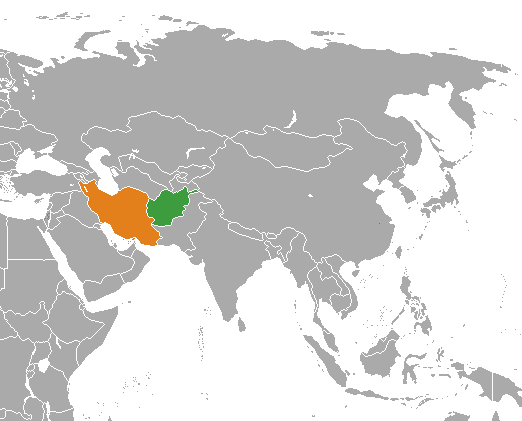
Photo by Pahari Sahib
BACKGROUND: In May 2023, Afghan authorities approved the Mazar-i-Sharif-Herat-Kandahar railway corridor project, which spans 1,468 kilometers. A year later, plans were announced for the construction of the Spin Boldak-Kandahar railway, signaling the intention to extend the Kandahar route to Pakistan. Turkmenistan promptly capitalized on this development by proposing an alternative version of the Trans-Afghan Corridor, extending along the Torghundi-Herat-Kandahar-Spin Boldak route.
Subsequently, Kazakhstan joined the project at the invitation of Ashgabat, and in September 2024, the foundation was laid for a 22-kilometer railway line connecting the border station of Torghundi to Sanobar. This section will serve as the initial segment of the Torghundi-Herat transport corridor.
The Turkmen version of the trans-Afghan railway is regarded as an alternative to the Kabul Corridor (the Termez-Mazar-i-Sharif-Kabul-Peshawar railway), although the latter route is significantly shorter. Competition between the western route (originating from Turkmenistan's border) and the eastern route (originating from Uzbekistan's border) appears inevitable. However, this competition is expected to yield positive outcomes, particularly through the reduction of transportation costs resulting from the launch of additional trade routes through Afghanistan. This cost efficiency is a critical factor driving the interest of external stakeholders in the development of trans-Afghan transport infrastructure.
The establishment of the Torghundi-Spin Boldak international transport corridor holds particular importance for Tehran, which intends to develop a railway link with Afghanistan through the border town of Zaranj.
Since 2020, as part of the broader development of Iran's deep-sea port of Chabahar, construction has been underway on the Chabahar-Zahedan railway. This railway is planned to extend further into Afghanistan, reaching the provinces of Nimroz and Kandahar. Recently, Afghan authorities announced the completion of engineering surveys for the construction of the Zaranj-Kandahar railway. This integrated infrastructure will provide Iran with an additional avenue to access Afghanistan, while also establishing a direct connection to Herat—one of Afghanistan's largest and most strategically significant cities.
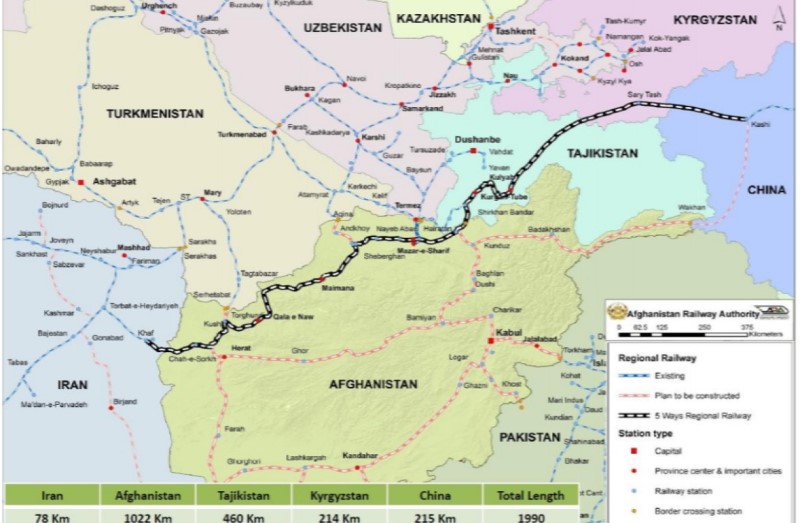
Tehran’s long-term strategic vision positions Herat as a pivotal hub for transit routes connecting Western, Central, and Eastern Asia. This perspective stems from the concept of the China-Kyrgyzstan-Tajikistan-Afghanistan-Iran railway corridor, commonly referred to as the "Five Nation Road." Iran has already initiated the practical implementation of this vision through the construction of the Khaf-Herat railway, which is scheduled to become operational in 2025. Once completed, the route will extend to Kashgar in China via Central Asia, covering an approximate distance of 2,000 kilometers.
IMPLICATIONS: Iran has consistently encouraged Afghan authorities to collaborate with their Central Asian partners in advancing the railway corridor connecting Khaf to Kashgar.
In 2017, Uzbekistan and Afghanistan reached an agreement to construct the Mazar-i-Sharif-Sheberghan-Maimana-Herat railway. Integrating this new route with the Khaf-Herat railway would enable Uzbekistan to establish an alternative transit corridor to Iran, Turkey, and the Gulf countries, bypassing Turkmenistan. Additionally, this development would have a substantial impact on the implementation of the Five Nation Transit Route, as the Khaf-Herat-Mazar-i-Sharif railway constitutes a critical segment of the Afghan portion of this corridor. From Mazar-i-Sharif, transportation links would only need to be extended to Sherkhan Bandar in Kunduz province to connect with Tajikistan's border.
However, in 2018, Tashkent introduced a new trans-Afghan railway project toward Pakistan, known as the Kabul Corridor, effectively placing the implementation of the Mazar-i-Sharif-Herat route on hold. This decision was likely influenced by the recognition that the railway to Herat could undermine Uzbekistan’s transit interests. By prioritizing the Kabul Corridor, Uzbekistan sought to secure its role in servicing freight flows from China, Kyrgyzstan, and Tajikistan to Iran, Turkey, and Europe.
Despite these developments, progress on the China-Kyrgyzstan-Tajikistan-Afghanistan-Iran railway corridor continued. In 2019, Afghanistan and Tajikistan signed an agreement to construct the Jaloliddini Balkhi (Kolkhozobod)-Panji Poyon-Sherkhan Bandar railway. To finance the feasibility study for this project, Dushanbe sought assistance from prominent international donor organizations, including the World Bank and the Asian Development Bank.
At that time, establishing a railway connection between Afghanistan and Tajikistan was also pivotal for the development of the Turkmenistan-Afghanistan-Tajikistan (TAT) transport corridor, initiated in 2013. This corridor extends from the Tajik border into northern Afghanistan, passing through the cities of Kunduz, Khulm, Mazar-i-Sharif, Sheberghan, and Andkhoy. At the Akina checkpoint, the railway crosses into Turkmenistan, from where it can connect to the Caspian Sea. This route aligns with the concept of reviving the ancient Lapis Lazuli Corridor, which aims to provide Afghanistan with direct access to European markets via the Caspian Sea, Azerbaijan, and Turkey.
In 2016, Turkmenistan completed the first stage of the TAT railway, spanning the Atamurat (Kerki)-Ymamnazar-Akina route. By early 2021, the Akina-Andkhoy railway line also became operational. However, the abrupt change of power in Afghanistan during the summer of 2021 led to the suspension of work on these projects. This pause stemmed from uncertainty regarding the Taliban government's approach to relations with neighboring countries and its foreign policy on transport communications. Yet contrary to initial expectations, the new leadership in Afghanistan adopted a notably more pragmatic stance on these matters.
The Taliban have reactivated nearly all regional and interregional transport projects. Announcements have been made regarding the planned launch of the Andkhoy-Sheberghan and Sheberghan-Mazar-i-Sharif railway lines in the coming years, as well as the construction of the Mazar-i-Sharif-Herat railway. These initiatives aim to bridge critical gaps in major trade corridors, including the TAT and the Five Nation Railway Route.
Notably, even Tajikistan, despite its tough stance toward the Afghan government, has become more active in advancing trans-Afghan transport initiatives. In July 2024, Tajikistan’s Ministry of Transport and the Korea International Cooperation Agency (KOICA) signed a protocol to develop a feasibility study for a 51-kilometer Jaloliddini Balkhi-Panji Poyon railway, which will connect to Afghanistan via the Sherkhan Bandar checkpoint. As previously mentioned, this railway will form part of the TAT.
Integration into such international transport corridors will offer Tajikistan a strategic advantage on southern transit routes. However, the modernization of existing infrastructure and the construction of new railways demand significant financial resources, which Dushanbe struggles to provide. Tajikistan relies heavily on China for foreign investment. Beijing has a vested interest in developing fast and efficient transportation routes to access emerging markets in South Asia, the Middle East, and Europe.
If the Taliban succeed in persuading Tajikistan to collaborate on developing trade routes to China, this could significantly reshape Central Asia's transport architecture while enhancing Afghanistan's strategic importance as a regional transit hub. Iran would also benefit from a direct connection to China that bypasses Turkmenistan, Uzbekistan, and Kazakhstan.
For Tashkent, however, this development could present a serious challenge given the resolve of its neighbors to complete the TAT.
CONCLUSIONS: The proactive efforts of the Taliban government in developing international transport links has heightened the interest of most Central Asian states (with the exception of Tajikistan) in strengthening trade and economic ties with Kabul. This includes the potential implementation of joint investment projects, such as the construction of railways, gas pipelines, and power lines, which could foster regional connectivity and economic growth.
External major powers are also eager to capitalize on these transformations, but their interference in establishing trans-Afghan transport infrastructure could have adverse consequences for Central Asia.
Iran’s ambitions to establish a transport corridor to China via Afghanistan pose the potential to alter the balance of power within the regional transit system. Such a development would bolster the positions of Tajikistan and Kyrgyzstan, which are currently in a transport deadlock and reliance on Uzbekistan for access to global markets.
The development of new trade routes through Afghanistan represents a positive trend that will inevitably influence Central Asia due to the region’s geographical proximity. This shift offers regional states the opportunity to enhance their transit and trade capacities, albeit accompanied by increased competition. To mitigate the risks of intense rivalries, the Central Asian republics must reconcile their interests in light of Afghanistan’s growing significance as a transit hub and formulate a coordinated strategy to advance interregional transport corridors, ensuring equitable benefits across the region.
AUTHOR’S BIO: Nargiza Umarova is a Senior Research Fellow at the Institute for Advanced International Studies (IAIS), University of World Economy and Diplomacy (UWED) and an analyst at the Non-governmental Research Institution “Knowledge Caravan”, Tashkent, Uzbekistan.
Her research activities are focused on studying developments in Central Asia, trends in regional integration and the influence of big powers on this process. She also explores the current policy of Uzbekistan on the creation and development of international transport corridors. She can be reached at This email address is being protected from spambots. You need JavaScript enabled to view it. .
Iran and Afghanistan Inaugurate Cross-Border Railway
By Sudha Ramachandran
April 27, 2021, the CACI Analyst
A new railway line running between Khaf in Iran and Herat in Afghanistan has generated much optimism in the two countries as it has the potential to boost bilateral travel and trade. The railway link is important to the larger region as well as it is part of the ambitious Five Nation Railway Corridor project. While there are great expectations of the FNRC project and the Khaf-Herat railway link’s recent inauguration in the participating countries, the road ahead will not be easy and the project faces implementation problems as well as competition from rival projects.
Baku-Tbilisi-Kars Railway to Become Central Asia's Gateway to Europe
By Fuad Shahbazov
December 7, 2017, the CACI Analyst
On October 30, 2017, Azerbaijan’s President Ilham Aliyev, along with Turkey’s President Recep Tayyip Erdogan, Georgia’s Prime-minister Giorgi Kvirikashvili, Kazakhstan’s Prime Minister Bakytzhan Sagintayev, and Uzbekistan’s Prime Minister Abdulla Aripov attended the opening ceremony of the long-delayed Baku-Tbilisi-Kars (BTK) railway. “The opening of the railway is of historic and strategic significance,” Aliyev said at the ceremony in the Caspian port city of Alat, south of Baku, to mark the departure of the first trains. In fact, the opening of the new railway provides an alternative route to existing rail services carrying goods from Asia to Europe.
Visit also