
By Nicola Ilario
For over four years, Russia’s war on Ukraine has been fought largely through attritional means. Each side has targeted the other’s economic infrastructure to force capitulation. But as Ukrainian strike capabilities have grown in rage and precision, that campaign has exploded well beyond the two countries’ borders, reaching into the Caspian basin. Strikes on Russian oil rigs, sanctioned vessels, and the Caspian Pipeline Consortium have inflicted real costs on Kazakhstan, a country with no stake in the conflict. The war, in other words, has expanded beyond its original battlefield.
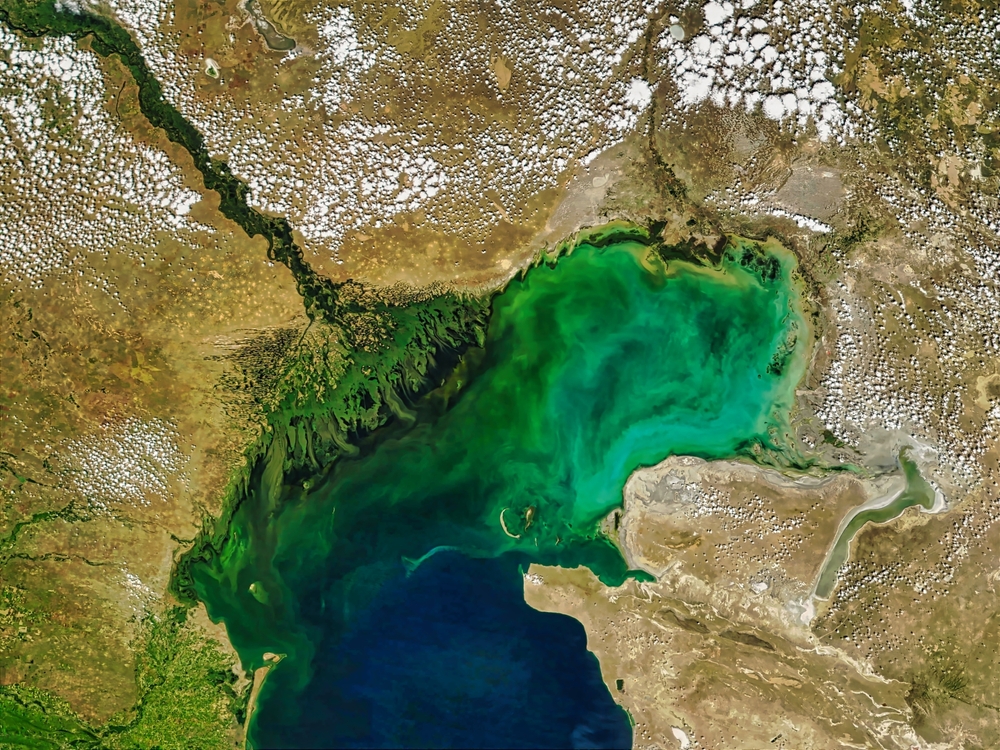
BACKGROUND: As of the second half of 2026, Russia’s full-scale-invasion of Ukraine has gone on for over 4 years, surpassing the length of the First World War. Though taking place over a century after the latter, the war in Ukraine shares many similarities, notably that they are both wars of attrition.
The Russian strategy of eroding Ukrainian resistance has come largely with strikes on Ukrainian energy infrastructure. Russia hopes that a steady deterioration and eventual collapse of the Ukrainian energy grid will push a situation where Ukraine would be forced to make peace on Russia’s terms. The Ukrainian strategy is similar in some regards but seeks to target the Russian economy as whole. While the Special Operations Forces (SOF), and Unmanned System Forces (USF) have systematically targeted Russian oil refineries, depots and occasionally energy production infrastructure, Ukraine has further gone on to target logistical warehouses, shipping lanes and other economic targets.
Ukraine’s campaign has been extensive, and has recently spread into the Caspian basin as Ukrainian capabilities grow. In December 2025, Ukrainian drones hit the Filanovsky and Korchagin oil rigs, part of Russia’s largest Caspian oil field, damaging equipment and suspending production. The attacks were not an exception, as multiple rounds of attempts were made at hitting the facility, demonstrating evidence of a sustained campaign and greater disruption.
Beyond attacking stationary targets like fuel depots and refineries, Ukraine has further gone on to strike sanctioned cargo vessels in the Caspian, and even a Russian missile boat. Then, in a dramatic move, Ukraine struck an Iran-linked vessel they claimed was carrying military equipment between Russia and Iran.
IMPLICATIONS: Ukraine’s campaign against Russia in the Caspian basin is evident, however the second order consequences of such attacks are just as important, as they not only affect the Russian economy, but the economies and security situations of all the countries in the Caspian.
Starting in February 2025, Ukrainian drones began targeting the Caspian Pipeline Consortium. The pipeline carries Caspian crude from the Tengiz oil field in Kazakhstan to the Novorossiysk-2 Marine Terminal, an export facility at the Russian Black Sea port of Novorossiysk and is hence economically important for both the Russian Federation and Kazakhstan. Though initially the attacks did not directly affect economic conditions outside of Russia, they have over time impacted Kazakhstan both financially and diplomatically.
The Caspian Pipeline Consortium has been struck repeatedly: in November 2025, January 2026, April 2026, and again in July 2026, with drones increasingly targeting the Novorossiysk-2 marine terminal’s loading equipment directly rather than the pipeline’s inland pumping stations. The January attack alone cost Kazakhstan an estimated US$ 1.5 billion, forced a roughly 6 percent cut to national oil production, and contributed to a 21.2 percent year-on-year decline in Kazakhstan’s oil export revenue in the first quarter of 2025.
Astana’s response has been both technical and diplomatic. Kazakhstan has formally protested that the strikes threaten global energy security, expedited the purchase of new mooring hardware to harden the Novorossiysk terminal against further damage, and, more consequentially, accelerated real cargo flows through the Baku-Tbilisi-Ceyhan pipeline as a working backup route rather than a hypothetical one. In effect, the drone campaign has done in months what years of Middle Corridor diplomacy had not: forced Kazakhstan to test how much of its alternative export capacity is actually usable under stress.
The results so far are small compared to the hope of what could be ultimately possible. KazTransOil moved around 700,000 tons of crude toward BTC through the port of Ataku in the first half of 2026, and state operator KazMunayGas has set a 2026 target of 1.7 million tons. This is a target that surpasses that of 2025 by 31 percent. However, these shipments are still a small fraction of the roughly 60 million tons Kazakhstan ships annually via Russian-linked routes.
Officials have floated the idea of eventually raising BTC volumes toward 20 million tons a year, though tanker capacity on the Caspian and the cost of blending heavier Kazakh crude to the pipeline’s Azeri Light specification remain binding constraints on how fast that can happen. Azerbaijan and Georgia separately revived the long-dormant Baku-Suspa pipeline in May 2026, and Kazakh officials have said they are discussing its use as a further outlet, though no formal proposal from Baku has been made as of now.
The Iranian dimension adds a second axis of risk. Tehran summoned Ukraine’s chargé d'affaires and issued a public protest to the EU after a strike on an Iranian-linked vessel killed a sailor, though regional analysts have largely read the strike as a demonstration of reach aimed at Russian-Iranian arms cooperation rather than the opening of a new front. That reading is complicated by an earlier Israeli strike on Iran’s Bandar Anzali port on the same sea, which has raised the possibility of Israeli-Ukrainian coordination. The Caspian is no longer a space where only one conflict’s logic applies, though it is unlikely the strike will escalate into anything larger.
The stakes extend beyond Russia and Kazakhstan bilaterally. Western oil majors, including Chevron and ExxonMobil, hold direct equity stakes in the Caspian Pipeline Consortium. This means disruption to the pipeline carries commercial consequences for U.S. and European firms, not just for Kazakh-Russian relations. This is a dynamic that a recent assessment ties directly to Ukraine’s parallel strikes on Russia’s Orenburg gas plant. Karachaganak’s gas is processed at Orenburg under a long-term supply contract, so when Ukrainian drones struck the plant in October 2025, and again in June 2026, Kazakhstan had to curtail gas intake there. Furthermore, because oil and gas condensate output at Karachaganak are tied together, oil production fell by roughly 25 to 30 percent each time. That reduced volumes directly for Chevron and Shell, which together hold a 47 percent stake in the Karachaganak consortium, making the field a second, non-CPC channel through which the war has hit Western-operated Kazakh production.
The Caspian strikes can be situated within that larger campaign: Ukrainian drone strikes have pushed Russian oil refining to a 24-year low, suggesting the Caspian theater is an extension of a broader economic-attrition strategy rather than an isolated escalation.
CONCLUSIONS: The Caspian basin is no longer insulated from the Russo-Ukrainian War. Kazakhstan is absorbing the bulk of these costs directly, but its neighbors’ exposure is more uneven than the corridor’s shared geography might suggest. Azerbaijan’s own Russia-linked route, the Baku-Novorossiysk pipeline, has for years run well below its roughly 5-million-ton annual capacity, more recently loading closer to 3 million tons of which roughly two-thirds is Kazakh. Baku at times had discussed reverse-flow arrangements to bring Russian oil south for domestic refining rather than depending on the line for its own exports, so its direct financial exposure to disruptions in the Caspian are limited. If anything, Azerbaijan and Georgia stand to gain. The two revived Baku-Supsa pipelines can, to the benefit of Baku and Tbilisi, capture Kazakh volumes diverted from CPC. Turkmenistan, whose exports do not run through the CPC/Novorossiysk corridor faces even less direct exposure.
Regional cooperation among Caspian states, and direct diplomatic engagement between Kyiv and Astana specifically, will matter for containing further spillover. However, Kazakhstan’s leverage to compel restraint from either belligerent is limited. What Astana can more plausibly control is its own exposure—to treat the diversification toward the Middle Corridor and Baku-Tbilisi-Ceyhan that the strikes have already forced in practice as an immediate operational priority.
AUTHOR’S BIO: Nicola Ilario is an undergraduate at the University of Pennsylvania. He studies Economics and History, with a concentration in the history of diplomacy. Nicola interned at the Central Asia-Caucasus Institute the Summer of 2026, assisting fellows in their research. He can be reached at This email address is being protected from spambots. You need JavaScript enabled to view it. .