
By Stephen Blank
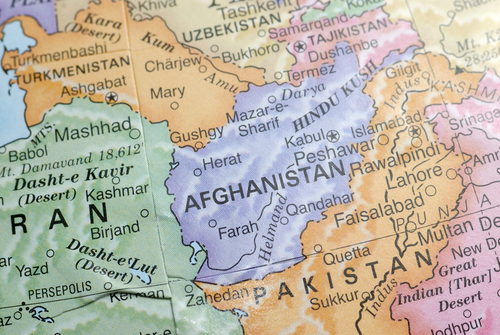
The Pakistan-Afghanistan war, on top of the war against Iran, is forcing Moscow to attempt to balance its security and economic interests in and beyond Central Asia with both Pakistan and Afghanistan. Pakistan is critical to Russia because it provides an alternative to Iran, allowing Moscow’s transcontinental trade project INSTC to move forward and offering a gateway to Asia. Concurrently, Moscow has upgraded its ties with the Taliban in Afghanistan both to deter ISIS-K terrorists and to secure broader geostrategic aims. Yet it also increasingly appears that Moscow is willing to offer Afghanistan arms, ostensibly to deter terrorists. However, in the broader regional context, this move underscores Moscow’s propensity for playing a double game with and against its partners.
BACKGROUND:
The Iran war and Pakistan’s war with Afghanistan threaten the further erosion of Russian influence in Central Asia. Consequently, Russia has embarked on what can only be called a double game vis-à-vis Pakistan and Afghanistan. Pakistan has attacked Afghanistan because it claims Afghanistan harbors the Tehrik-e-Taliban Pakistan (TTP) terrorist group, which performs attacks against Pakistan. This complaint is more than a little ironic given Pakistan’s own long-standing and well-known record of sponsoring terrorism against India. More significant, however, is the fact that this charge, if true, signifies that Kabul has escaped Islamabad’s tutelage. However, the war also disrupts Russia’s ambition to sell Russian gas to South and Southeast Asia through pipelines traversing Afghanistan and Pakistan.
At the same time, Russia has steadily built a “full-fledged” and “pragmatic” partnership with Afghanistan to prevent it from sponsoring terrorist groups like ISIS-K and their targeting of Russia and Central Asia, where Russia still claims to be the ultimate security manager. According to Sergei Shoigu, Secretary of Russia’s Security Council, full-fledged partnership includes bilateral defense and security cooperation. Indeed, Shoigu openly proclaimed Russia’s opposition to any third-party military presence in Afghanistan or neighboring countries, a shot across both Pakistan’s and the U.S.’s bow and a sign of its ambition to establish a protectorate over Afghanistan.
However, Russia’s interests transcend defense. The war against Iran has ruptured the feasibility of Russia’s, Iran’s and India’s major transit, trade and connectivity route through Central Asia and then through Russia to Europe, the INSTC (multi-modal International North-South Transportation Corridor). The other existing corridor, the increasingly lucrative Middle Corridor or TITR (Trans-Caspian International Transport Route) from China to Central Asia and then to the Caucasus and Europe bypasses Russia. Thus, since failure to find an alternative to Iran for INSTC will have dire geoeconomic and geopolitical consequences for Russia, it has turned to Pakistan for help. Pakistan cannot afford exclusion from transcontinental trade routes and has agreed to explore connecting its port at Gwadar either by land or by sea to INSTC.
IMPLICATIONS:
Moscow typically has sought to have a foot in both camps in every conflict scenario throughout the Global South and the Pakistan-Afghan war is no exception. But this case is far more central to Moscow’s interests than its power projection in for example Africa or the Middle East. In order to maintain its self-appointed “leading position” in Central Asia, it is crucial for Russia to exercise leverage over Afghanistan to deter an outbreak of Islamic terrorism targeting either Central Asia or Russia.
Likewise, it is critical to Russia’s economic health and continuing ability to finance its war against Ukraine and its heavily strained state budget that it continues to find Asian markets for its oil and gas. Doing so also entails developing trade routes like INSTC to Pakistan, India and Southeast Asia, especially given its desire to be acknowledged as an independent Asian power. Therefore, balancing between Pakistan and Afghanistan while developing alternatives to Iran’s connectivity have become requirements of Russian policies to realize vital Russian interests, especially as its economy is reeling and its position in Central Asia erodes.
Further erosion is inevitable if Islamic terrorism “migrates” to Central Asia without Moscow being able to deter or stop it. By the same token, exclusion from transcontinental trade routes will undermine Moscow’s ideological and rhetorical pretense of hegemony, and demonstrate that Russia lacks the means in terms of tangible material capability to back up its arguments or sustain a position that answers to Central Asia’s most pressing questions, i.e. economic development.
Concurrently, if Russia cannot develop let alone sustain viable, economically justifiable outreach to South and Southeast Asia, its hard-won influence and standing in those countries will diminish by an order of magnitude, negating its claims of being an Asian power and making it still more dependent on China.
Despite its vital need to keep the balance between Pakistan and Afghanistan, many recent reports suggest that Moscow is secretly negotiating an arms deal with the Taliban. Ostensibly, the aim would be to use the weapons to suppress ISIS-K and prevent further terrorist strikes in Central Asia and or Russia. While this makes sense if leveraging Russia’s Central Asian position and ambitions vis-à-vis Afghanistan are the priority; in reality, it highlights the priority of security over economic development in Russian policy. It also illustrates the abiding temptation to make secret deals involving the security services or force structures as primary instruments of foreign policy.
Given the Taliban’s track record, it is unlikely that it can or will hold up its end of the bargain. Moreover, should these reports be true this news will enrage Pakistan and likely torpedo efforts to have it join INSTC. That trade project, unlike the Middle Corridor, never got off the ground and is therefore already being eclipsed. This has gravely serious and negative implications for Russia and is likely to aggravate all the trends making for the decline of Russian power in the Caucasus and Central Asia as well as South and Southeast Asia.
An arms deal with the Taliban will further entrench the belief among governments who monitor Russian behavior that Moscow is cannot be relied on as a partner. It will also confirm the notion held by many Western governments that Russia, like the Soviet Union, remains a sponsor of state terrorism and must, at best, be kept at arm’s length.
CONCLUSIONS:
Thus Russia continues to play a double game towards its partners, attempting to have both an empire and prosperous foreign trade relations, even though their logics are quite incompatible. Moscow also has yet to grasp that it cannot denounce and support terrorism at the same time without paying an incommensurate price for its quest after short-term gains. In Central Asia, Russia still seeks to pursue wildly contradictory aims without paying the price for doing so. If Moscow does, in fact, arm the Afghan government, it will once again be playing with dynamite.
AUTHOR’S BIO:
Stephen Blank is a Senior Fellow with the Foreign Policy Research Institute, www.fpri.org.